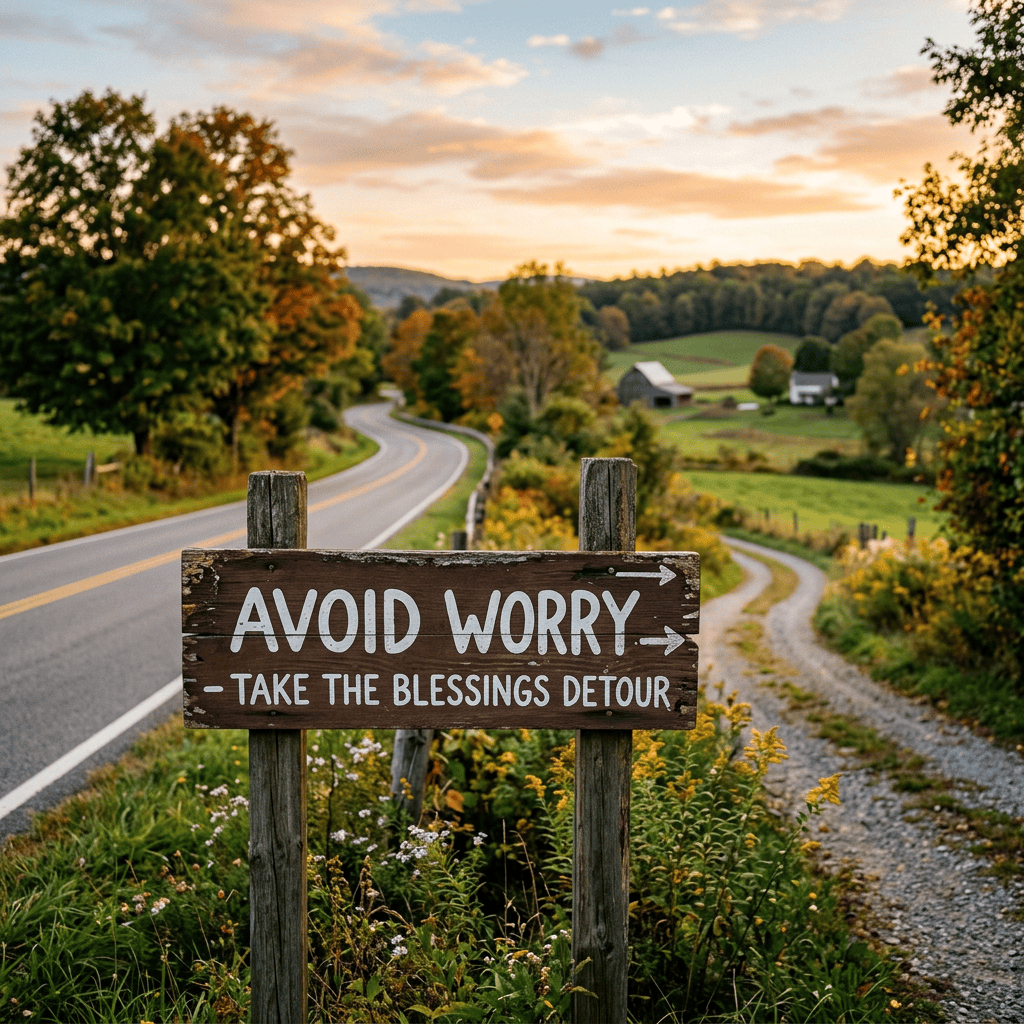
At first, you may think this is an odd question. You’re thinking, “Of course the Lord has provided for my needs today,” but have you stopped to count those blessings?
Sometimes, life’s worries can overshadow the blessings. It’s easy to spend today worrying about tomorrow. We think about upcoming responsibilities, unanswered questions, and problems that may arise. Before long, our minds become consumed with the future, so we may miss the blessings sitting right in front of us.
So don’t worry about tomorrow, for tomorrow will bring its own worries. Today’s trouble is enough for today.
Today’s blessings may not come in dramatic packaging. They may be the strength to get out of bed or an encouraging conversation. Perhaps you’re blessed with finances arriving at just the right time or peace you can’t explain amid a storm. God often works in ways that are easy to overlook when we are distracted by tomorrow’s concerns.
Take a moment today to notice the Lord’s blessings. Look for evidence of his goodness. You may discover the solution to tomorrow’s challenge is already unfolding today.
Pip: Get Encouraged lives up to its name this week — Chris Miller has been quietly asking the kind of questions that sound simple until you actually sit with them.
Mara: The posts cover three territories: trusting God with what you already have, the underestimated power of showing up and encouraging others, and what it actually looks like to find contentment.
Pip: Let's start with what's already in your hands.
God Uses What You Have
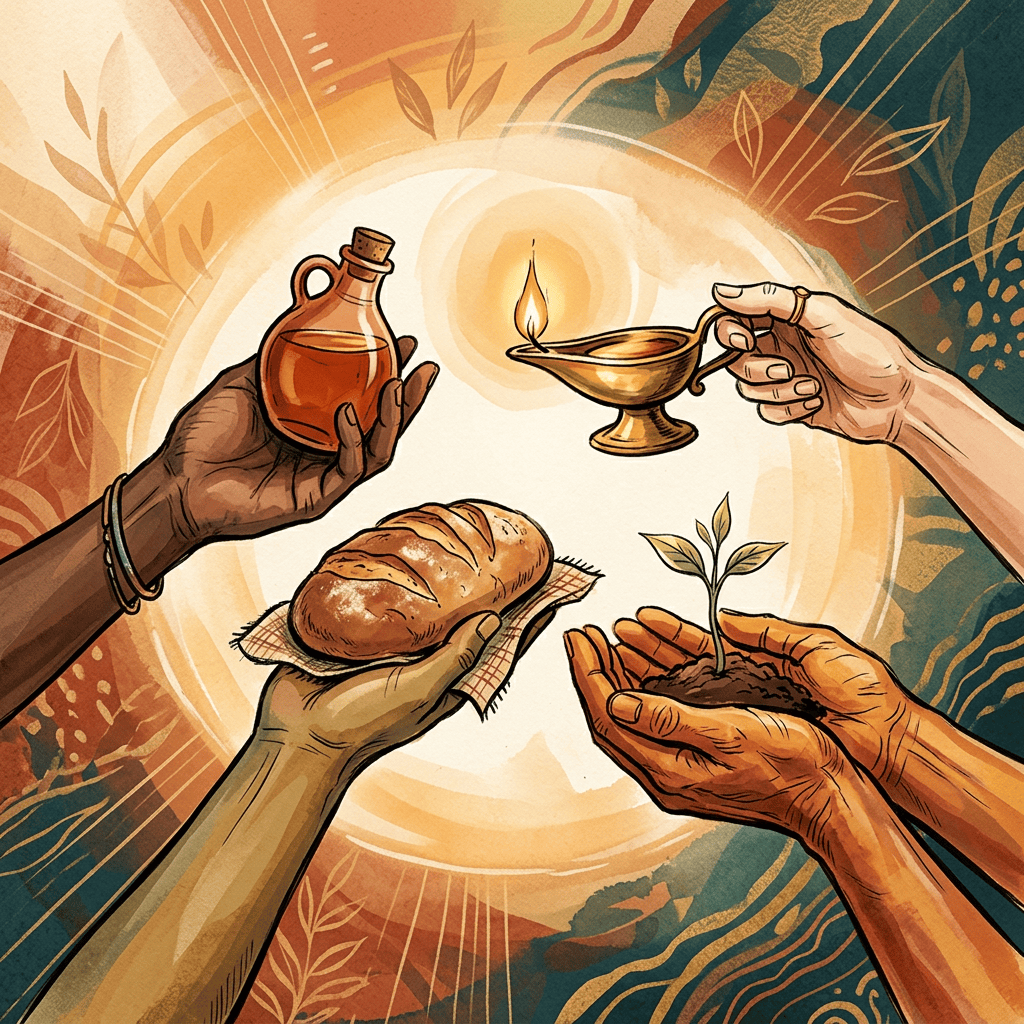
Mara: The setup in 2 Kings 4 is stark — a widow with creditors at the door and almost nothing left. Elisha's question cuts right to it: "What do you have?"
Pip: And her answer, as the post "What Do You Have in Your Hands" records it, is the whole point. She says, "Nothing at all, except a flask of olive oil."
Mara: That flask becomes the starting point for everything. She borrows empty jars, starts pouring, and the oil keeps flowing until the jars run out. She pays her debts and has enough left to live on.
Pip: So the upshot is: the limitation wasn't the obstacle. The limitation was the opening.
Mara: The post frames it plainly — we may look at our resources and see limitations, but God sees possibilities. Time, influence, ability — the question isn't whether you have enough, it's whether you'll offer what you do have.
Pip: "Bring Your Empty" takes that a step further. The widow couldn't manufacture oil, but she could bring empty jars — and that's the move faith actually requires.
Mara: And "I Believe, But Help My Unbelief" sits right alongside that — the father in Mark 9 is stretched to the end of his faith, crying out honestly, and Jesus meets him there anyway.
Pip: Start with what you have. That's the thread running through all of it.
Mara: Which raises a question about how we actually reach people once we've decided to show up.
Quiet Influence And Encouragement
Mara: Sometimes the most powerful thing you can offer isn't a solution — it's your presence. "Showing Up" opens with a line most of us know from the inside: "I don't know what to say."
Pip: And the answer the post lands on is Romans 12:15 — "Be happy with those who are happy, and weep with those who weep."
Mara: No perfect words required. A hospital visit, a phone call, a handwritten note — these communicate the one thing people most need to hear: you are not alone.
Pip: "You're an Influencer" makes the same argument about scale. Your circle doesn't need to be large to matter. Jesus puts it in Matthew 5:14 — "You are the light of the world — like a city on a hilltop that cannot be hidden."
Mara: Light doesn't perform. It just shines. Consistent modeling of love and compassion works the same way.
Pip: And "Be Like Barnabas" names the person who did this best in the early church — someone who believed in Paul when others were skeptical, and gave John Mark another chance after failure.
Mara: His name literally means son of encouragement. The post's point is simple: the world has critics. What it needs are more Barnabases.
Pip: Presence, influence, encouragement — all of it assumes you're actually at peace enough to give it away.
Contentment And Trust
Pip: Finding contentment sounds passive, but "Finding Contentment" opens with a 114-year-old woman who called it a daily choice.
Mara: Eunice Sandborn said she had a happy life and no complaints — and acknowledged there were seasons where she had to actively choose that. The post anchors on Hebrews 13:6: "Be satisfied with what you have. For God has said, 'I will never fail you. I will never abandon you.'"
Pip: That's not a promise tied to circumstances. It holds in the lean seasons and the full ones alike.
Mara: Exactly — and that's the ground everything else in this episode stands on.
Pip: Offer what you have, show up for the people around you, and trust the one who doesn't abandon you in the lean seasons.
Mara: Simple questions with a lot of weight. More next time.
Your greatest opportunity to impact the world may be closer than you think.
When we think of influence, we often think of a large Instagram following or millions of views on a YouTube video, yet our most impactful influence can actually be small in number. It can be at home, work, church, or among friends. The Lord maximizes our impact within our circle.
As a parent, you shape the lives of your kids. As a coworker, you may encourage a struggling colleague. You may model faithfulness during challenging circumstances. These actions may never make headlines, but they matter tremendously.
In Matthew 5, Jesus compares us to light. “You are the light of the world—like a city on a hilltop that cannot be hidden” (Matthew 5:14).
Light doesn’t have to do anything to draw attention to itself. It only has to shine, and in doing so, illuminates what is around it. It is very difficult to ignore light. It naturally has an impactful influence.
In the same way, it can be very difficult to ignore consistent modeling of Jesus’ love and compassion. It organically creates an impactful influence for us.
Friends, God has placed people in our lives for a reason. Model his love. Show his grace and compassion today. Our words, actions, attitudes, and example can be a light pointing others, right around us, toward Christ.
Never underestimate the impact of consistent faithfulness. You may be influencing more people than you realize.
His son was in trouble, and the father’s world was rocked almost to its core. Mark tells us an evil spirit had seized the boy and would often cause him to have convulsions. This would often cause the boy to fall into fire or water. The dad had faith, but his faith had been pulled to its very end. He couldn’t see a way out of this circumstance. Filled with desperation, he cried out to Jesus.
As they were explaining the situation to Jesus, the people said, “The spirit often throws him into the fire or into water trying to kill him. Have mercy on us and help us if you can.’ ‘What do you mean if I can,’ Jesus asked. ‘Anything is possible if a person believes,” records Mark 9:22-23.
Then verse 24 states, “The father instantly cried out, ‘I do believe but help me overcome my unbelief!”
No Relief
His son was enduring a horrific problem, and this dad’s world was shaking violently as he was amid a monstrous trial. We know he requested the disciples help, and we can assume he sought help elsewhere. Nothing was working though. No matter where he turned it seemed there was no end to this father’s crisis. Day after day, night after night, seizure after seizure the boy’s condition continued, and it seemed there was no relief from the crisis. Can you relate?
Our world is rocked by a trial. As our world trembles, we search for solid footing, but we can’t find it. The longer we seek a solution, the more discouraged we become. We believe the Lord has a plan, but our eyes are blurred by the current season so we can’t see how to get through it. In these moments, Scripture suggests we follow the example of the father. We seek wisdom from the Lord to help us.
James 1:5-8 encourages, “If you need wisdom, ask our generous God, and he will give it to you. He will not rebuke you for asking. But when you ask him, be sure that your faith is in God alone. Do not waiver for a person with divided loyalty is as unsettled as a wave of the sea that is blown and tossed by the wind. Such people should not expect to receive anything from the Lord. Their loyalty is divided between God and the world, and they are unstable in everything they do.”
The Way Out
While we may not see it today, we can have confidence the Lord will lead us out of our crisis. The way out may not be immediate. It may involve several steps, but the Lord will get us there. We know he will because he has helped so many before us.
Remember how he helped the people of Israel. They were headed out of their trial in Egypt. They needed to cross the Red Sea, so God made the wind blow. They needed water, so the Lord made it pour out of a rock. The people needed to eat, so God made manna fall from Heaven. There were several steps in ending the trial, but the Lord showed Israel the way.
Jesus stopped the father’s world from shaking. Jesus released the grip of the evil spirit. In 9:25-27, Mark records, “He said, ‘I command you to come out of this child and never enter him again.’ Then the spirit screamed and threw the boy into another violent convulsion, and left him. The boy appeared to be dead…. But Jesus took him by the hand and helped him to his feet, and he stood up.” The trouble was over. The boy was free and the father’s crisis ended because of Jesus.
If your world is shaking today and you do not see how the Lord is going to get you through this crisis, remember he will. He has helped people get through, and he will help you. Echo the words of the father, “I do believe, but help me Lord because I don’t see it right now.”
Pip: Get Encouraged lives up to its name this week — Chris Miller has been busy covering the kind of territory most of us navigate quietly: doubt, invisibility, setbacks, and the stubborn ordinary Tuesday.
Mara: Right — the posts move through questions we bring to God, what it means to feel unseen, and how to find footing when plans fall apart or a new start feels daunting. Let's begin with what it looks like to bring our doubts to the right place.
Growth and a Teachable Heart
Pip: The question here is whether doubt disqualifies us — or whether what we do with our questions is what actually matters.
Mara: The Thomas story makes the case directly. Jesus doesn't turn him away; he shows up and says, "Put your finger here, and look at my hands. Put your hand into the wound in my side. Don't be faithless any longer. Believe!"
Pip: So the posture is: bring the hard question to the right person, not away from him. Thomas's doubt became a doorway, not a dead end.
Mara: "A Teachable Heart" extends that same logic beyond doubt into daily growth. It quotes Proverbs: "Instruct the wise, and they will be even wiser." The obstacle to growth, the post argues, is believing we have nothing left to learn.
Pip: Doubt and teachability turn out to be the same coin — both require admitting we don't have the full picture yet.
Mara: On to what happens when that picture includes feeling completely invisible.
Overlooked but Seen
Pip: This segment sits with a specific ache — working hard, caring faithfully, and receiving exactly zero acknowledgment for it.
Mara: "You Are Noticed" addresses that directly. Jesus says, "Give your gifts in private, and your Father, who sees everything, will reward you." The post lists who this covers: the caregiver, the behind-the-scenes volunteer, the worker doing honest daily tasks.
Pip: There's something quietly countercultural about that. The whole post is essentially arguing that the unwitnessed act is not the wasted act.
Mara: And the companion piece — the podcast episode on feeling overlooked — extends the same encouragement in audio form for anyone who'd rather listen than read. The throughline is the same: faithfulness in secret still registers with God.
Pip: From being seen to figuring out where to go when the ground shifts — that's the next stretch.
Change, Setbacks, and New Starts
Pip: This is the biggest territory in the episode — what to do when the plan collapses, the start line resets, or an ordinary day feels like it's going nowhere.
Mara: "Ordinary Days Have Extraordinary Opportunities" opens with a verse from Zechariah: "Do not despise these small beginnings, for the LORD rejoices to see the work begin." David tending sheep, the disciples at their nets, a boy with a lunch — the examples are all people who didn't know they were mid-story.
Pip: So the ordinary Tuesday isn't a waiting room. It's already the thing.
Mara: "When the Plan Changes" picks up the harder version of that — when the ordinary day becomes a derailed one. It quotes Proverbs 19:21: "You can make many plans, but the LORD's purpose will prevail." Ruth leaving her homeland, Paul's rerouted journeys — redirection reframed as protection or preparation.
Pip: And then there's "The Courage to Begin Again," which is for the person who isn't just rerouted but fully starting over — job gone, relationship ended, dream dissolved.
Mara: It leans on Joshua 1:9: "Be strong and courageous! Do not be afraid or discouraged. For the LORD your God is with you wherever you go." The point isn't that the path is clear — it's that the company is reliable.
Pip: "Look Beyond Today's Pain to Tomorrow" carries that further — holding pain and hope in the same frame, the cross as the model for how suffering isn't the final sentence.
Mara: Psalm 118:6 anchors it: "The Lord is for me, so I will have no fear." The post's argument is that present pain doesn't get the last word, even when we can't see what comes next.
Pip: Doubt, invisibility, setbacks — turns out the thread running through all of it is the same question: is anyone paying attention?
Mara: And the consistent answer across all of it is yes — whether it's Thomas getting a direct response, or the unseen caregiver, or the person restarting from scratch.
You work hard every day, but it seems everyone else receives the recognition and praise.
You’re constantly on the move to care for your home and family, but you don’t even receive a grunt of thanks from your spouse.
You give it your all, but it seems no one notices. It can be discouraging, and if this is you, the Bible offers encouragement.
Jesus says, “Give your gifts in private, and your Father, who sees everything, will reward you” (Matthew 6:4). These few words offer much encouragement.
Our culture celebrates visibility. We’re encouraged to seek attention, yet much of the Christian life takes place where few people are watching. It can be…
A quiet prayer.
An unseen act of kindness.
A faithful commitment that no one else recognizes.
These moments matter, and Jesus teaches that our Heavenly Father sees what is done in secret. Nothing goes unnoticed.
Dwell on this for a second. This is really encouraging!
If you are…
The person caring for a loved one. The Lord notices your compassion, love, and dedication.
The volunteer serving behind the scenes. The Lord sees your commitment and dedication even when others don’t.
The worker performing daily tasks with integrity. The Lord applauds your honesty and hard work.
The Christian quietly living out their faith. The Lord recognizes your daily faithfulness.
If you feel overlooked today, remember that your faithfulness is never wasted. The God who sees in secret values every act of obedience done for his glory.
You’re not alone. Many people have questions, and the Lord welcomes our questions. Jesus shows us this truth in his response to Thomas.
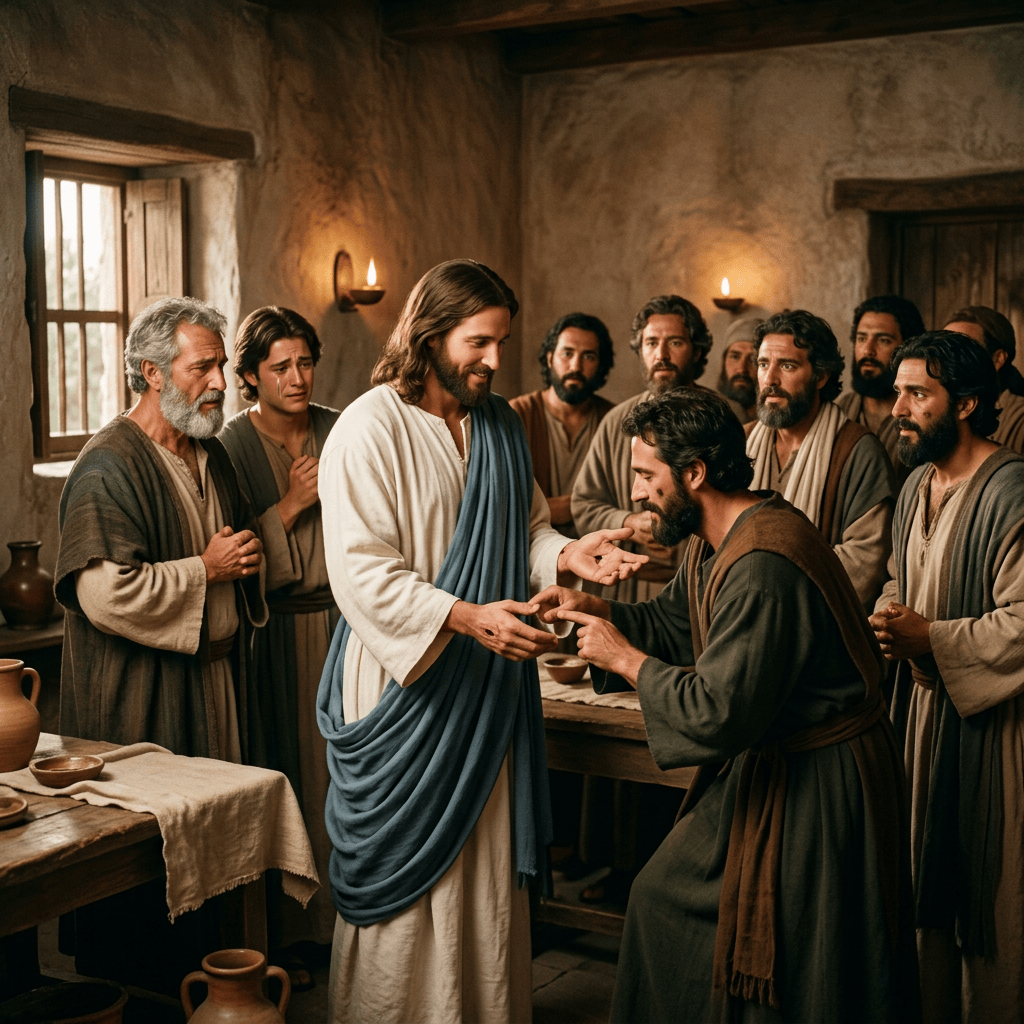
Thomas struggled to believe because he wanted certainty. He wanted evidence. When he learned of Christ’s resurrection, Thomas said, “I won’t believe it unless I see the nail wounds in his hands, put my fingers into them, and place my hand into the wound in his side” (John 20:25).
Instead of rejecting Thomas, Jesus met him where he was.
“Eight days later the disciples were together again, and this time Thomas was with them. The doors were locked; but suddenly, as before, Jesus was standing among them. “Peace be with you,” he said. Then he said to Thomas, “Put your finger here, and look at my hands. Put your hand into the wound in my side. Don’t be faithless any longer. Believe!” (John 20:26-27).
Christ graciously provided what Thomas needed and strengthened his faith.
Many believers experience seasons of questions and uncertainty. We wonder why God allowed a certain situation. We struggle to understand his timing. We wrestle with difficult circumstances. As we do, Jesus meets us just as he did Thomas.
Questions do not automatically indicate weak faith. What matters is what we do with them. Thomas brought his doubts to the right person, and we should as well.
God invites us to seek Him honestly and sincerely. Scripture says, “Pour out your heart to him, for God is our refuge” (Psalm 62:8). The Lord desires for us to come as we are, which includes bringing our questions. The more we draw near to him, the more we discover that he is trustworthy.
If you have questions today, don’t run from God. Rather, run to him. The Savior who welcomed Thomas still welcomes searching hearts today.
Pip: Get Encouraged — where the month ends, a new one begins, and someone is quietly asking whether any of it is adding up to something.
Mara: Chris Miller has been writing through that exact tension this week — posts about remembering where God has already shown up, trusting him with what comes next, and handing over the weight when it gets too heavy to carry.
Pip: Let's start with the rearview mirror — remembering faithfulness before stepping into whatever's ahead.
Faithfulness And Reflection
Mara: The prompt here is simple but easy to skip: before you move into a new month, pause and actually account for what God has already done — answered prayers, provision, moments of sustaining grace.
Pip: "Remember His Faithfulness" reaches for Deuteronomy to make the case, and the verse lands with some weight: "Understand, therefore, that the Lord your God is indeed God. He is the faithful God who keeps his covenant for a thousand generations and lavishes his unfailing love on those who love him and obey his commands."
Mara: The upshot is practical — the Israelites built physical memorials for exactly this reason. Remembering past faithfulness is a faith-strengthening discipline, not just a sentimental exercise.
Pip: And the closing line earns its place: you may not know what lies ahead, but you know the one who goes before you. That's the bridge into what comes next — what does it look like to trust God when the path ahead isn't visible?
God's Ongoing Guidance
Mara: Two posts here share the same core question: when your circumstances feel unfinished or uncertain, how do you keep moving forward?
Pip: "God is Still Writing Your Story" opens with the feeling most of us recognize — goals slipping, plans not unfolding, discouragement settling in because all you can see is what hasn't happened yet.
Mara: The anchor verse is Philippians 1:6: "God, who began the good work within you, will continue his work until it is finally finished on the day when Christ Jesus returns."
Pip: What that means in practice is that the chapter you're stuck in right now is not the conclusion. Joseph didn't end in prison. David's years in hiding weren't the final word. Your current circumstances don't tell the whole story either.
Mara: "How Bright is Your Flash Light?" takes that same idea and gives it a concrete image — walking a dark trail with only enough light to see the next step. Psalm 119:105 is the hinge: "Your word is a lamp to my feet and a light to my path." Not a floodlight. A lamp.
Pip: So the ask isn't full visibility — it's enough light for the next step. Which is either deeply comforting or deeply inconvenient, depending on the day.
Mara: Both posts land in the same place: trust what you've been given for today, and keep moving. There's also a companion audio episode of the story post available on Spotify for anyone who prefers to listen.
Pip: And if moving forward feels less like walking a trail and more like carrying a pressure cooker — that's exactly where we're headed.
Burdens And Pressure
Mara: This segment is about weight — what to do when life piles on faster than you can process it, and where to actually put it down.
Pip: "Hand It Over: Giving God Our Burdens" is direct. The invitation is right there in Psalm 55:22: "Give your burdens to the Lord, and he will take care of you."
Mara: The plain-language consequence is that God doesn't expect you to carry those burdens alone. The post names the specific categories — work worries, financial strain, family difficulties, health concerns — and says the invitation is the same regardless of which one is weighing on you.
Pip: The honest footnote is that the burdens may not disappear immediately. But the promise is access to a strength and peace that exceed your own.
Mara: "Too Much Pressure" works the same territory through a pressure-cooker metaphor — useful under the right conditions, dangerous with too much buildup. The Psalmist in Psalm 119 is the anchor there: "As pressure and stress bear down on me, I find joy in your commands. Your laws are always right. Help me to understand them so I may live."
Pip: He's describing real pressure — consumed, troubled, surrounded — and still finding the pivot point in God's Word rather than in the circumstances themselves.
Mara: The post also pulls in John 14:1: "Do not let your hearts be troubled. Trust in God; trust also in me." The through-line across both posts is the same — you can't always control what's pressing in, but you can control where you turn with it.
Pip: Short version: hand it over. Easier said, worth doing.
Mara: Remember what's behind, trust what's ahead, release what's too heavy — it's a complete posture, not just three separate ideas.
Pip: And apparently one week's worth of posts is enough to outline a whole theology of not falling apart. We'll see what next week brings.
Pip: Get Encouraged lives up to its name this week — Chris Miller has been busy writing about the things that actually keep people up at night: guilt, fear, exhaustion, and Monday mornings.
Mara: That covers the territory well. We're looking at posts on healing and hope, gratitude and purpose at work, facing fear, and finding rest when the weight gets heavy.
Pip: Let's start with the hardest one — the question of whether your past has to define you.
Healing And Hope In Hard Times
Mara: These posts sit with people in the middle of pain — whether that's guilt, grief, or a life that stopped going according to plan.
Pip: The anchor here is a retelling of John 8, and the line that lands hardest is Jesus speaking directly to the woman the crowd wanted to stone: "Neither do I. Go and sin no more."
Mara: What the post draws out is that everyone else had already left. The accusers, the crowd — gone. And the point is that Jesus stayed, and what he offered wasn't a pass on accountability but something more specific: grace and a fresh start.
Pip: The post puts it plainly — her past did not have to define her future. And then it turns that outward, asking whether the reader needs to hear the same thing.
Mara: Romans 8:1 gets pulled in there too: "there is now no condemnation for those who belong to Christ Jesus." The guilt you keep carrying may already be taken.
Pip: That theme runs into the other two posts here. "Healing from a Broken Heart" covers the grief side — loss, betrayal, death — and leans on Psalm 34:18, which says the Lord is close to the brokenhearted.
Mara: And "Finding Hope in Unexpected Life Events" addresses the disorientation of plans collapsing — the diagnosis, the lost opportunity — and reminds readers that Joseph, Moses, and David all looked stuck before they weren't.
Pip: So whether the wound is guilt, grief, or derailment, the answer being offered is the same: you are not at the end of the story.
Mara: Which makes the next question — how you show up while you're still in the middle of it — worth sitting with.
Gratitude And Purpose At Work
Pip: If the healing segment is about surviving hard seasons, this one is about what you do with an ordinary Tuesday.
Mara: "Work as Worship" opens with Colossians 3:23-24: "Work willingly at whatever you do, as though you were working for the Lord rather than for people. Remember that the Lord will give you an inheritance as your reward, and that the Master you are serving is Christ."
Pip: So the upshot is that the audience for your work is not your employer or your performance review — it's larger than that, which reframes what counts as significant.
Mara: The post is specific about this. Answering a customer's question, stocking a shelf, emptying a trash can — each one is framed as something that improves a real person's real day. The scale of the task doesn't determine the weight of the impact.
Pip: That's the quiet argument: nothing done faithfully is wasted, which is either deeply comforting or a lot of pressure depending on your Monday.
Mara: "How Gratitude Transforms Tough Days" picks up the same thread from a different angle. It draws on 1 Thessalonians 5:18 — "Be thankful in all circumstances" — and makes the case that gratitude isn't denial of hardship; it's a shift in focus toward what God has already provided.
Pip: Counting blessings on a hard day sounds like advice from a greeting card, but the post earns it — it frames gratitude as something that sharpens your awareness of faithfulness rather than papering over difficulty.
Mara: And if gratitude can reframe a hard day at work, the next question is what to do when the obstacle isn't a bad Tuesday but something that stops you from moving at all.
Facing Fear And Taking Next Steps
Pip: Fear, the posts argue, wants to write your story for you — and it is not a reliable narrator.
Mara: "Embrace Your Next Step" puts it directly with Isaiah 41:10: "Don't be afraid, for I am with you. Don't be discouraged, for I am your God. I will strengthen you and help you. I will hold you up with my victorious right hand."
Pip: What that means in practice is that faith and fear are looking at the same obstacle from opposite directions — fear sees the limitation, faith sees what's behind it.
Mara: The companion piece, the podcast episode "Is Fear Holding You Back," extends that conversation in audio form for anyone who wants to keep going on this one.
Pip: When fear loses its grip, what's usually left is exhaustion — and that's where the last post comes in.
Rest For The Weary
Mara: "Find Rest: Jesus' Invitation for the Weary" is built around Matthew 11:28-30: "Come to me, all of you who are weary and carry heavy burdens, and I will give you rest."
Pip: The post is careful to say you don't have to wait until the burden is already gone to accept that invitation — you come now, with the weight still on.
Mara: Worry, anxiety, stress, past mistakes, relational difficulty — the post lists them as examples, but the offer is the same regardless of the source. Rest is the promise attached to coming.
Pip: Grace for the past, purpose in the ordinary, courage for the next step, rest for right now — that's a lot of ground to cover in a week.
Mara: The through line is that none of it requires perfect circumstances first. More on that next time.