Are you tired? You’ve been carrying that burden far too long, and it is weighing you down. The extra weight is becoming more than you can carry alone. The weight is more than you can bear, and the good news is you don’t have to carry it by yourself.
“Then Jesus said, ‘Come to me, all of you who are weary and carry heavy burdens, and I will give you rest. Take my yoke upon you. Let me teach you, because I am humble and gentle at heart, and you will find rest for your souls. For my yoke is easy to bear, and the burden I give you is light” (Matthew 11:28-30).
Your burden could be worry, anxiety, stress, past mistakes, or difficulty in a relationship. No matter the source of the heavy burden, the offer for help is the same.
Jesus invites us…
To come to him.
To bring our burdens to him.
To allow him to help carry the weight.
Friend, we don’t have to wait until we’re no longer carrying the burden. Jesus invites us to come now, and the invitation comes with a promise.
Jesus’ invitation comes with a promise of rest. He can take the burden and replace it with rest, giving us some peace.
So, if you’re weighed down by burdens today, remember Jesus’ invitation. “Come to me,” he invites, “and find rest.”
A crowd had gathered, and Jesus was teaching. We aren’t told what he was talking about. Maybe it was compassion. Maybe it was anxiety. We simply don’t know.
Then, suddenly, the door burst open.
A group of men came rushing in, dragging a woman into the middle of the crowd.
“We caught this woman in the act of adultery,” one of them shouted. “The law says we should stone her. Jesus, what do you say?”
It was a trap.
But Jesus didn’t answer right away.
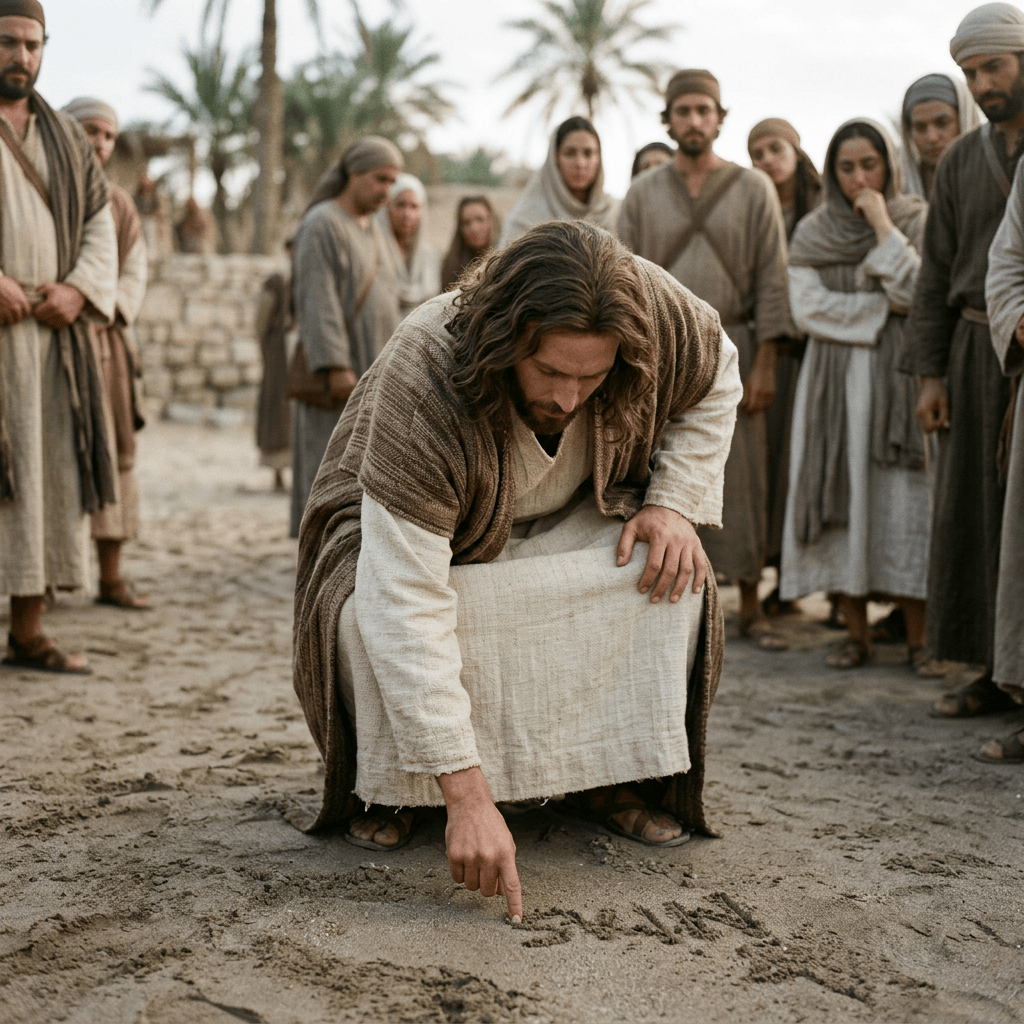
John 8 tells us that he bent down and began writing in the dust. We aren’t told what he wrote or exactly why he did it. Perhaps he was making a point or simply giving everyone a moment to think.
Whatever the reason, the crowd kept demanding an answer.
Finally, Jesus stood and said:
“All right, but let the one who has never sinned throw the first stone!” (John 8:7).
At this, tension lessened, and the atmosphere of the room suddenly changed.
One by one, the accusers slipped away. The oldest left first, followed by the others, until there was no one left but Jesus and the woman.
Jesus then asked her:
“Where are your accusers? Didn’t even one of them condemn you?”
“No, Lord,” she replied.
And Jesus said:
“Neither do I. Go and sin no more” (John 8:11).
Focus on that scene for a moment.
Everyone else had walked away. The accusations were gone. The condemnation was gone. Only Jesus remained, and he offered her something she desperately needed: grace and a fresh start.
Her past did not have to define her future.
Maybe you need to hear that today.
Sometimes the hardest person to forgive is ourselves. We remember what we did, said, and mistakes we wish we could undo. Even when everyone else has moved on, we continue carrying the guilt of the past, but Jesus offers freedom.
Romans 8:1 reminds us that “there is now no condemnation for those who belong to Christ Jesus,” and Galatians 5:1 says, “It is for freedom that Christ has set us free.”
Jesus didn’t tell the woman that what she had done didn’t matter. He told her to “go and sin no more.” But he also refused to condemn her.
That’s grace.
So the next time the guilt of your past comes knocking, remember the woman in John 8.
Remember that your mistakes don’t have the final word.
Remember that Jesus offers forgiveness, grace, and a fresh start.
You don’t have to keep carrying the guilt Jesus has already taken away.
Let his grace replace your guilt with the peace that only he can give.
Pip: Get Encouraged arrives this week with a cluster of posts that all seem to circle the same restless question: what do you do when life feels like it is moving faster than your faith can keep up?
Mara: Chris Miller is the writer behind all of it — covering worry, silence, gratitude, neighbor love, and what it looks like to stay rooted when the wind picks up. Let's start with the territory a lot of us know too well: trusting God through silence and worry.
Trusting God When Worry Knocks
Pip: The question running through this segment is one most people won't admit out loud — what do you do when worry fills the calendar the same way meetings do, or when you pray and hear nothing back?
Mara: The post "Today's Tasks: Why Worry About Tomorrow?" sets it up directly. Jesus says, "Don't worry about tomorrow for today has enough worries of its own."
Pip: Which is either deeply comforting or the most efficient out-of-office reply ever written. But the real point stands — today's agenda is already full; worry about tomorrow is an uninvited guest.
Mara: "Understanding God's Silence: Trusting in His Timing" takes the harder case — when prayer feels like it's bouncing off the ceiling. It points to Job, Joseph, and the silence before Jesus' birth as examples where God was working invisibly. Psalm 46:10 is the anchor: "Be still, and know that I am God."
Pip: That's the practical upshot — silence isn't absence. The post is essentially saying God's timing has a track record, even when you can't see the work in progress.
Mara: "Overcoming Worry: Biblical Insights for Peace" extends that into daily life, pointing to birds and flowers as creation's sermon on provision. And there's a Spotify episode, "Are You Worried? A Practical Way to Help Overcome Worry," that offers a more hands-on angle for listeners who want to take the next step.
Pip: From worry about tomorrow, it's a short walk to how we see the people standing right in front of us today.
Gratitude, Neighbors, and What We Choose to See
Pip: The frame here is perspective — specifically whether gratitude and neighbor love are feelings that happen to us or choices we make about what we're looking at.
Mara: "Finding Gratitude in Every Situation" quotes Paul from Colossians 2:7, saying that when our lives are rooted in Christ, we will "overflow with thankfulness." Not occasionally find something — overflow.
Pip: The post illustrates it with a neighbor's fallen tree that took out an old, ugly bush they'd been wanting removed anyway. Circumstances unchanged; perspective shifted.
Mara: "Seeing Our Neighbor as God Does" carries that outward — asking whether we extend the same generous view to the people who frustrate us that we extend to ourselves, because God's love covers them too.
Roots Deep Enough to Hold
Pip: When the wind actually arrives — not as a metaphor but as a literal fallen tree — the question becomes whether your roots were deep enough before the storm started.
Mara: "Strengthening Your Faith Roots in Tough Times" opens with exactly that: a neighbor's evergreen going down on a sunny, windy day. The diagnosis is the root system, not the wind. Paul's words from Colossians 2:6-7 follow: "Let your roots grow down into him and let your lives be built on him, then your faith will grow strong."
Pip: So the upshot is practical — you can't control the wind, but you can decide how deeply you're rooted before it arrives.
Mara: The post offers four concrete suggestions: daily time in Scripture, prayer, recalling God's faithfulness, and cultivating thankfulness. "Why Labor Day Reminds Us to Work Hard and Rest Well" adds a companion idea — that rest itself is part of God's design, not a failure of productivity. Jesus' invitation in Matthew 11:28 is the anchor there: "Come to me, all you who are weary and burdened, and I will give you rest."
Pip: Deep roots, honest rest, and a perspective that can find the blessing in a fallen tree. Not a bad place to land.
Mara: Worry, silence, gratitude, neighbors, roots — it's all circling the same question of where we're anchored when life gets loud.
Pip: Next time, we'll see what else is growing over at Get Encouraged. Stay rooted.
How full is your calendar today? If you are like me, it is pretty full. Between work, getting the kids to school, and running errands, there is just not a lot of time for anything else. Especially worry about tomorrow. That’s why it is encouraging to find this nugget of wisdom tucked away in Matthew 6.
Jesus says, “Don’t worry about tomorrow for today has enough worries of its own” (Matthew 6:34)
As we think of all that is coming and all that may happen tomorrow, it is easy to let worry creep into our lives. However, Jesus encourages us not to worry about those events and days in the future. We are reminded the Lord has our back. He is going to take care of tomorrow. After all, today’s agenda is full. there’s no room for worry about tomorrow.
Are you worried? While we may not want to acknowledge it, most of us spend time throughout the day worrying. Our calendars are full, and we need more time. Our bank accounts are low, and there are bills to pay. Life is hectic. Worry seems to invade our thoughts, so the Bible has encouragement for these times.
Jesus says, “So don’t worry about these things, saying, ‘What will we eat? What will we drink? What will we wear?’ These things dominate the thoughts of unbelievers, but your heavenly Father already knows all your needs. Seek the Kingdom of God above all else, and live righteously, and he will give you everything you need” (Matthew 6:31-33).
“Don’t worry,” Jesus encourages. As he says this, he points to the birds and flowers. Neither worry, yet the Lord meets their needs. If nature’s needs are met, how much more will the Lord take care of us?
Friend, Jesus’ words are true. Worry will always try to invade our thoughts, but faith can be our defense. God invites you to trade your worry for his peace.
So when anxiety rises, pause and look outside. See the birds. Notice the flowers. Let creation preach to you: “If God cares for them, he cares for me too.”
Pip: Some days arrive with more questions than answers — which, honestly, describes most Tuesdays. Chris Miller's recent writing at Get Encouraged leans straight into that feeling.
Mara: It does. We're covering two stretches of territory today: what it looks like to trust God when life gets hard, and what the Bible actually says about who you are — grace, identity, and forgiveness.
Pip: Let's start with the trust question, because that's where the ground gets unsteady.
Holding On When the Road Gets Hard
Mara: The animating question here is simple but serious: when life keeps throwing difficulty at you, what do you actually hold onto?
Pip: The anchor post goes straight to Romans 8, and the claim is sweeping. Here's the line: "nothing — not death, life, angels, demons, our fears today, our worries about tomorrow, or anything else in all creation — can separate us from the love of God revealed in Christ Jesus."
Mara: That's the spine of the piece. The argument is that God's love isn't conditional on circumstances improving — the diagnosis, the lost job, the relationship that fell apart, none of it moves the needle on that love.
Pip: Which is a remarkable thing to say to someone in the middle of a hard season, rather than after it.
Mara: Exactly. And the post on Joseph's story in Genesis fills that out with a long example. Joseph gets sold into slavery by his brothers, falsely accused, thrown in prison — and the piece quotes Genesis 50:20 directly: "You intended to harm me, but God intended it for good to accomplish what is now being done, the saving of many lives."
Pip: So the prison wasn't a detour. It was the road.
Mara: That's precisely how the post frames it. The piece on Jeremiah 33:3 makes a related move — God's invitation in hard times isn't "figure it out," it's "call to me and I will answer you." The recipe is simple, even when the situation isn't.
Pip: And then there's the root metaphor — a neighbor's evergreen toppled by wind because the root system was too shallow. Strengthening Your Faith Roots in Tough Times uses Colossians 2 to argue that deep roots in Scripture and prayer are what hold when the storms arrive.
Mara: Trusting God's Promises When Life Gets Hard and Embracing Change both reinforce that. One anchors on Psalm 12:6 — God's promises are pure, refined like silver. The other lands on Hebrews 13:8: Jesus is the same yesterday, today, and forever. The stability is in the person, not the circumstances.
Pip: So the through-line is: you can't control the wind, but you can decide how deep the roots go.
Mara: That's it. And that question of who you are underneath the hard seasons connects directly to the next territory — identity and grace.
Who You Are Has Already Been Decided
Pip: This segment is really asking one question: where does your worth actually come from, and does it move when your circumstances do?
Mara: Your Worth: More Than Achievements goes at that directly. The setup is that we live in a world constantly measuring by accomplishment, but the Bible asks something different. Here's the line from 1 John 3:1: "See what great love the Father has lavished on us, that we should be called children of God!"
Pip: So the status isn't earned — it's given. John doesn't say you might become a child of God if you work hard enough.
Mara: Right. The post makes that explicit: your worth isn't your résumé, your reputation, or the number of people who approve of you. Identity is rooted in belonging, not in performance. Children don't earn their place in a family — they belong because they're family.
Pip: That's a genuinely different accounting system than most people are running.
Mara: It is. And You're Priceless: Understanding God's Grace pushes that further — the title itself is the thesis. Grace means the value was assigned before you did anything to deserve it.
Pip: Which makes the self-forgiveness question almost inevitable. If the value doesn't depend on your record, then carrying guilt for a record God has already addressed is — well, it's working from the wrong ledger.
Mara: Have You Forgiven Yourself? sits right there. The logic that runs through all three posts is consistent: your identity in God doesn't fluctuate with your failures, so the invitation is to actually receive what's already been given.
Pip: The priceless tag isn't aspirational. It's already true.
Mara: And that's worth sitting with — because the hard seasons covered earlier look different when you're not also carrying the weight of feeling like you have to earn your way back.
Pip: Deep roots, unshakeable love, an identity that doesn't depend on the scoreboard — that's the territory.
Mara: Next time, we'll see what else is growing at Get Encouraged. Stay with it.
Pip: Get Encouraged lives up to its name this week — Chris Miller has been writing about the things people quietly wrestle with: whether they're worth loving, whether fear wins, whether mercy is still available after everything they've done.
Mara: The posts cover grace and self-worth, finding peace when fear gets loud, and what it looks like to choose mercy — both toward others and toward yourself. Let's start with the question of whether you have to earn God's love at all.
Grace and Self-Worth
Pip: The thread running through this segment is one most people have felt but rarely say out loud — the suspicion that you have to clean yourself up before God will really accept you. These posts push back on that directly.
Mara: The post "You Are Priceless: Understanding God's Grace" sets the foundation with Ephesians 2:4–5: "But God is so rich in mercy, and he loved us so much, that even though we were dead because of our sins, he gave us life when he raised Christ from the dead."
Pip: The detail that lands there is the timing. God's love wasn't conditional on improvement — it arrived at the lowest possible point. That reframes the whole idea of earning worth.
Mara: Exactly, and the post makes that explicit: "Grace means God's mercy meets us where we are, not where we think we need to be." The argument is that value isn't something you accumulate through performance — it's already been declared.
Pip: Which is a genuinely hard thing to believe when you've been keeping score on yourself for years.
Mara: That's precisely where "Learning to Show Mercy to Yourself" picks up. It points out that we often extend mercy freely to others while remaining relentlessly critical toward our own past selves — replaying old mistakes, punishing ourselves for things we can't change.
Pip: And it's not just a feelings problem — there's a theological claim underneath it. If God's mercy is real, withholding it from yourself is a kind of contradiction.
Mara: "Understanding God's Delight in Us" takes that even further. It draws on Zephaniah 3:17 to argue that God doesn't merely tolerate us — he rejoices. The post asks what prayer might look like if we approached God as a loving Father rather than a disappointed judge.
Pip: Meanwhile, "God's Grace: Your Support in Times of Struggle" handles the practical side — what grace actually does when the struggle doesn't disappear. It's less about feeling worthy and more about not having to face hard things alone.
Mara: That post quotes Paul directly: "My grace is all you need. My power works best in weakness." The upshot is that God's grace doesn't require the problem to be solved first — it meets you inside the difficulty.
Pip: So the whole cluster is really one argument: stop waiting to be good enough, because that's not how this works.
Mara: Which connects naturally to what happens when fear makes that waiting feel urgent — let's go there next.
Finding Peace When Fear Gets Loud
Pip: Fear has a way of making everything feel like a problem you have to solve immediately. This post asks whether peace actually requires having the answers.
Mara: "Finding Peace in God's Presence Amid Fear" quotes Zephaniah 3:17 directly: "With his love, he will calm all your fears." The claim is that God's presence doesn't just accompany fear — it quiets it.
Pip: So peace isn't downstream of certainty. It's downstream of proximity — knowing who is standing beside you, not knowing how everything resolves.
Mara: The post "Even Now: You Can Return to God" sits alongside this as a reminder that the door back is always open — the starting point for finding that peace is simply turning toward it.
Pip: That's a short distance to travel, even when it doesn't feel like it. Speaking of resistance — there's one more territory to cover.
Mercy and Spiritual Resistance
Pip: This segment pairs two things that don't obviously belong together: how you treat people who wrong you, and how you fight temptation. The connection is that both require actively choosing a response rather than defaulting to the easier one.
Mara: "Choose Mercy Over Blame in a Divided World" anchors it with Luke 6:36–38: "You must be compassionate just as your Father is compassionate. Do not judge others, and you will not be judged. Do not condemn others, or it will all come back against you. Forgive others, and you will be forgiven."
Pip: And the post is careful to say mercy isn't the same as pretending harm didn't happen — it just refuses to let blame have the final word. That's a meaningful distinction.
Mara: "Power of Scripture: Fight Temptation Effectively" makes a parallel move. It quotes James 4:7 — "Resist the devil and he will flee from you" — and points to Jesus in the wilderness as the model: answer temptation with Scripture, not negotiation.
Pip: Blame and temptation both want a passive response. Both posts say: don't give them one.
Mara: Grace that meets you where you are, peace that doesn't require certainty, mercy you can give and receive — these aren't separate ideas.
Pip: They're the same idea from different angles. More of that next time.
The devil doesn’t have to defeat you if he can convince you to stop fighting. Don’t let the enemy push you around. Fight back.
James gives us some powerful advice: “Resist the devil and he will flee from you” (James 4:7).
Notice the word resist. James doesn’t tell us to ignore the devil or surrender when temptation comes. He tells us to stand our ground.
That doesn’t mean Satan won’t fight back. He will. He will keep looking for opportunities to tempt, discourage, distract, and deceive us. But with the Lord’s help, we don’t have to give in.
One of our greatest weapons is Scripture.
Jesus showed us exactly how powerful God’s Word can be. While Jesus was in the wilderness, Satan tempted Him repeatedly (Matthew 4). Each time, Jesus responded by quoting Scripture. He didn’t debate Satan. He didn’t negotiate with him. He answered temptation with the truth of God’s Word.
Eventually, Satan left.
The same enemy who tempted Jesus will try to tempt us. He may keep coming back, trying a different approach or catching us at a moment of weakness. But we can keep resisting. We can keep standing on God’s truth. We can keep answering the enemy’s lies with Scripture.
Keep resisting, keep trusting, and keep standing on God’s Word.
The enemy may keep coming, but when we stand with the Lord, we don’t have to stand alone.