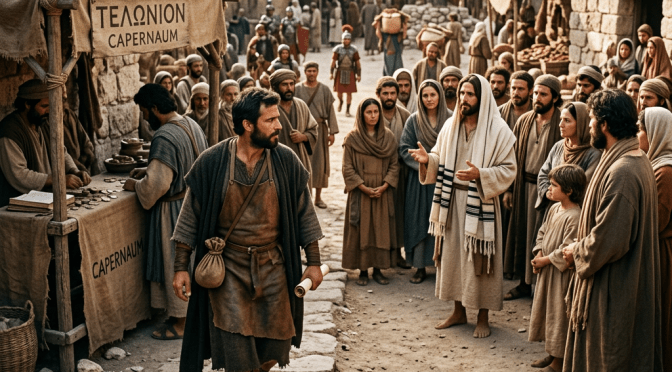
Have you ever chased something you were convinced would make you happy, only to discover it left you emptier than before? Many people spend their lives pursuing money, success, or possessions, hoping they’ll finally find satisfaction. Matthew learned the hard way that what we pursue determines what fills our hearts.
Matthew was a tax collector. He wasn’t well liked, and he often collected more money than people actually owed so he could keep the extra for himself. Wealth had become his pursuit.
Then one ordinary workday became the most extraordinary day of his life.
As Matthew sat at his tax booth, Jesus walked by with a crowd following him. Looking directly at Matthew, Jesus simply said, “Follow me.” Those two words changed everything. Matthew left his tax booth behind and soon found himself hosting a dinner where Jesus was the guest of honor.
That day, Matthew discovered what Jesus teaches in the Sermon on the Mount:
“God blesses those who hunger and thirst for righteousness, for they will be satisfied” (Matthew 5:6).
Matthew’s life changed because his desires changed. He stopped living to accumulate wealth and began pursuing a relationship with Christ. Instead of taking advantage of people, he learned to love them. Instead of searching for satisfaction in what he could gain, he found lasting joy in the one who had found him.
The promise of Matthew 5:6 is still true today. Every heart is hungry for something. Some chase success. Others pursue comfort, approval, or financial security. Yet none of those things can satisfy the deepest longings of the soul. Only Jesus can.
So ask yourself: What am I pursuing today? Whatever you hunger for will shape your life. Chase the things of this world, and you’ll always need more. Hunger for Christ, and you’ll discover the satisfaction your heart has been searching for all along. Taste and see for yourself. The Lord is good.
Our world often celebrates the loudest voice, the strongest personality, and the person with the most influence. We’re taught that real power is found in getting our own way. However, Jesus paints a very different picture.
“Blessed are the meek, for they will inherit the earth” (Matthew 5:5).
Meekness is not weakness. It is strength that has been surrendered to God. A meek person may have great ability, influence, or authority, but they choose to use those gifts to honor God and serve others rather than promote themselves. No one demonstrated this better than Jesus.
Although He possessed all power, Jesus never used it for selfish gain. He healed the sick, fed the hungry, welcomed the outcast, and cared for the brokenhearted. He used his power to lift others up instead of elevating himself.
Jesus invites us to live with that same kind of strength. We may not have the ability to perform miracles, but every day we have opportunities to use what God has given us for the good of others. We can choose patience instead of anger, humility instead of pride, forgiveness instead of retaliation, and service instead of self-promotion. We can use our words to encourage, our resources to help those in need, and our influence to point people toward Christ rather than ourselves.
When we surrender our strength to God, we begin to reflect the character of Jesus. In a world that often equates power with control and recognition, Christ calls us to demonstrate a different kind of greatness. True strength is not found in demanding our own way but in faithfully serving others. As we follow his example, we discover that meekness is not losing. It is actually gaining; it is living with the quiet confidence that God is in control, and that is the kind of life he promises to bless.
Pip: Get Encouraged lives up to its name this week — Chris Miller has been quietly covering the terrain most of us are actually living in: fear, exhaustion, waiting, and the slow work of becoming something better.
Mara: Right — the posts move through trusting God when life gets hard, finding him present in the silence, and what genuine spiritual growth actually looks like. Let's start with what to do when everything falls apart at once.
Standing Firm When Life Shifts
Pip: The question underneath this whole segment is a practical one: when the phone call comes, when the diagnosis lands, when the thing you were counting on disappears — what does faithful response actually look like?
Mara: Paul's letter to the Corinthians gives a direct answer. The post draws on 1 Corinthians 16:13-14: "Be on guard. Stand firm in the faith. Be courageous. Be strong. And do everything with love."
Pip: Five instructions, and the last one is doing the most work. You can be alert and firm and courageous and still be harsh about it — Paul's point is that the how matters as much as the what.
Mara: That's exactly where the post lands. It says our strength shouldn't make us harsh, our courage shouldn't make us arrogant, and standing firm shouldn't produce bitterness. Jesus modeled all four qualities and remained compassionate in every interaction.
Pip: Fear gets its own treatment too. Finding Strength in Fear looks at David in Psalm 56 — a man whose life was genuinely in danger — and notes that he doesn't pretend the fear isn't there.
Mara: David's move is to bring the fear to God rather than let it take the wheel. And for the nights when worry simply won't let you sleep, Rest Easy, Trusting Your 24/7 Watchman for Better Sleep pulls from Psalm 121 — the God who watches over you never slumbers.
Pip: Which is a different kind of courage than gritting your teeth through it.
Mara: When Life Weighs You Down takes that further, drawing on Jeremiah 31:25: "For I have given rest to the weary and joy to the sorrowing." The point is that God doesn't respond to exhaustion by telling us to try harder — he meets us in it.
Pip: Strength as something received rather than manufactured. That reframe runs through all of these.
Mara: And it sets up a natural question — what do you do when you've been trusting and waiting and still nothing seems to move?
God Sees You in the Silence
Pip: The hardest version of waiting isn't chaos — it's silence. The question here is whether God's quiet means he's gone.
Mara: Why God's Silence Doesn't Mean He's Absent goes to Exodus 3:16, where God tells Moses: "I have been watching closely, and I am indeed concerned about you." That statement comes after generations of Israel's suffering with no visible answer.
Pip: So the silence wasn't absence — something was being worked that the people couldn't see from inside it.
Mara: The companion piece, When God Seems Absent, extends that conversation in audio form for anyone who wants to sit with the question longer. Both point the same direction: unseen doesn't mean forgotten.
Pip: From waiting on God to what grows in us while we wait — that's where we're headed next.
What Grows When We Admit We Need Help
Pip: Spiritual growth tends to get framed as accumulation — more knowledge, more discipline. These posts push back on that with a different starting point.
Mara: John's Story opens with a man who had accumulated everything and still typed one word into YouTube: hope. What he found was Matthew 5:3 — "God blesses those who are poor and realize their need for him, for the Kingdom of Heaven is theirs."
Pip: Empty hands as the actual entry point. That's a harder sell than a self-improvement plan, but it's the one that apparently worked.
Mara: The Master Gardener, Cultivating Spiritual Growth picks up the growth side — Jesus in John 15 describing God as a gardener who prunes not carelessly but purposefully, so the branch produces more. The fruit that follows, from Galatians 5, is love, joy, peace, patience, kindness — qualities that grow slowly under the gardener's hand.
Pip: Pruning and emptiness as the same gesture, really. Both are about clearing what's in the way.
Mara: Guard, stand firm, trust, rest, admit need — it's a coherent thread across everything here.
Pip: Less a checklist, more a posture. We'll see what the next batch of posts builds on top of it.
Few experiences in life are as painful as saying goodbye to someone we love. Grief has a way of leaving us feeling empty, confused, and wondering if anyone truly understands the ache in our hearts.
Martha and Mary knew that feeling all too well. Their brother, Lazarus, had died. They had sent for Jesus, hoping He would arrive in time, but when He finally came, four days had already passed. Friends and neighbors had gathered to mourn with them, and the sadness was overwhelming.
Jesus loved Lazarus. He loved Martha and Mary too. As He saw their tears and the grief surrounding Him, something remarkable happened. Even though Jesus knew He would soon raise Lazarus from the dead, He didn’t dismiss their sorrow or tell them to stop crying. Instead, He entered into their pain. The shortest verse in the Bible simply says, “Jesus wept” (John 11:35).
That moment reminds us of an incredible truth: Jesus doesn’t stand at a distance when we are hurting. He draws near. He understands our pain, and his heart is moved by our sorrow.
Perhaps that’s why Jesus declared, “Blessed are those who mourn, for they will be comforted” (Matthew 5:4).
Notice the promise isn’t that we will never experience grief. The promise is that we will not experience it alone. The God who wept at a friend’s tomb is the same God who walks beside us through every valley of loss, disappointment, heartbreak, and sorrow.
If you’re carrying a heavy burden today, remember that your tears are not unnoticed. The Lord sees them. He cares about what you’re going through, and he promises his comfort to those who come to him. One day, he will wipe away every tear forever. Until that day, his presence is our comfort, his promises are our hope, and his love will never leave us.
Some people spend their entire lives chasing what they believe will finally make them happy. A bigger house. A larger bank account. A nicer vehicle. They reach one goal only to discover another still waiting on the horizon.
John thought he had finally arrived. His beautiful home, expensive car, and overflowing bank account suggested he had everything anyone could want. But there was a secret behind his success. His money came from running drugs, and while no one around him questioned his lifestyle, his own conscience never stopped asking difficult questions.
One morning, after pulling into his garage, John sat in silence. He looked around at everything he owned, but instead of satisfaction, he felt an overwhelming emptiness. The possessions that once made him proud suddenly felt meaningless. He realized he could buy almost anything money could offer, yet he couldn’t purchase peace, purpose, or genuine relationships. If he disappeared tomorrow, he wondered if anyone would even notice.
Desperate for something he couldn’t explain, John pulled out his phone and typed one word into YouTube: hope.
One of the first videos he found included these words of Jesus:
“God blesses those who are poor and realize their need for him, for the Kingdom of Heaven is theirs” (Matthew 5:3).
Those words lingered in his mind throughout the day. For the first time in a long time, John realized that hope wasn’t found in what he owned. Hope began when he admitted what he lacked. His greatest need wasn’t more money or more possessions. It was God.
The same is true for each of us.
Jesus isn’t saying we must be financially poor to be blessed. He is talking about those who recognize their spiritual need. The doorway to God’s grace begins with humility. When we admit we cannot save ourselves, we discover that God has already provided everything we need through Jesus Christ.
The Bible reminds us of that hope:
“For this is how God loved the world: He gave his one and only Son, so that everyone who believes in him will not perish but have eternal life. God sent his Son into the world not to judge the world, but to save the world through him” (John 3:16-17).
“But if we confess our sins to him, he is faithful and just to forgive us our sins and to cleanse us from all wickedness” (1 John 1:9).
“For his unfailing love toward those who fear him is as great as the height of the heavens above the earth. He has removed our sins as far from us as the east is from the west” (Psalm 103:11-12).
The greatest blessing in life is not found in what we possess but in the one who possesses our hearts. When we come to God with empty hands, admitting our need for him, he fills our lives with the forgiveness, hope, and purpose we could never find on our own. No matter what your past looks like or what burdens you carry today, God’s invitation remains open. Take the first step. Admit your need for him, trust in his promises, and discover the hope that only Christ can give.
Thanks for reading. If this post encouraged you, please consider sharing it with someone who may need this reminder today.
Pip: Get Encouraged is a site that does exactly what it says — and this week, Chris Miller brings the kind of writing that meets you in the middle of a hard Tuesday.
Mara: The posts cover three distinct territories: trusting God when worry and weariness set in, the kingdom impact of small and faithful acts, and — perhaps unexpectedly — Christmas joy in the middle of July.
Pip: Let's start with what to do when the weight of a hard season starts to feel bigger than anything else.
Trusting God In Worry And Weariness
Mara: The question running through this cluster of posts is a simple one: when life feels too heavy, what do we actually hold onto?
Pip: The anchor text here is Isaiah 40:28, quoted directly: "Have you never heard? Have you never understood? The Lord is the everlasting God, the Creator of all the earth. He never grows weak or weary. No one can measure the depths of his understanding."
Mara: So the upshot is that the God who made everything has not run out of capacity for your specific problem. That's the claim — and it's a load-bearing one.
Pip: It reframes the whole equation. We measure our burdens against our own strength and lose. The post asks us to measure them against something that doesn't have a ceiling.
Mara: Finding Peace in Worry and Redirecting Negative Thoughts to Positive Reflection push this further. Philippians 4:6 gets cited — "Don't worry about anything; instead, pray about everything" — and Philippians 4:8 follows with the instruction to fix your thoughts on what is true and honorable and lovely. Prayer and intentional thinking as active redirects, not passive comfort.
Pip: Finding Patience in Difficult Times adds the honest admission that the hard season might just… keep going. David's words from Psalm 62 — "He alone is my rock and my salvation, my fortress where I will not be shaken" — are offered not as a shortcut out but as ground to stand on while you wait.
Mara: And the podcast episode When the Journey Seems Too Long carries that same thread into audio form for anyone who'd rather listen than read.
Pip: Small acts of faithfulness while waiting — that's actually a good bridge into what comes next.
Small Acts With Lasting Kingdom Impact
Mara: The tension here is one a lot of people feel quietly: does what I'm doing actually matter if no one is noticing?
Pip: The Importance of Your Role in God's Kingdom answers that directly. First Corinthians 3:7 is the spine: "So neither the one who plants nor the one who waters is anything, but only God, who makes things grow."
Mara: What that means in practice is that the harvest isn't your job. Your job is the faithful act in front of you — the kind word, the small conversation, the seed planted without knowing what comes next.
Pip: And "small" is doing a lot of work here, because Small Things, Big Impact: The Power of One makes the case that Heaven's accounting looks nothing like ours.
Mara: Luke 15 is the evidence — three parables, one consistent point. A shepherd leaves ninety-nine sheep for one. A woman turns her house upside down for one coin. A father runs down the road for one returning son. The post quotes the refrain directly: "There will be more rejoicing in heaven over one sinner who repents."
Pip: Heaven doesn't wait for a crowd to celebrate. That's a genuinely different standard than the one most of us are quietly measuring ourselves against.
Mara: The ripple image from that post stays with me — one act of faithfulness traveling further than you can see, like a stone dropped in still water. One conversation, one invitation, one small class taught faithfully. The post puts it plainly: when God uses you to reach one life, you've participated in something that echoes into eternity.
Pip: From the long reach of faithful acts to a joy that's also been traveling a long time — just not seasonally.
Unexpected Christmas Joy
Mara: Christmas Joy in July makes a case that sounds odd until it doesn't: the joy that arrived in Bethlehem was never meant to be seasonal.
Pip: Isaac Watts apparently knew this. The post quotes him: "Joy to the world, the Lord is come! Let earth receive her King; Let every heart prepare Him room."
Mara: Those words hold on a hot Tuesday in July the same as they do in December. Jesus is still King. His presence, the post argues, is not a winter phenomenon.
Pip: Don't wait until December to rejoice — that's the whole thing, and it lands.
Mara: A God who doesn't grow weary, a kingdom that grows through ordinary faithfulness, a joy that doesn't wait for the right season — these aren't separate ideas.
Pip: They're the same encouragement from three directions. More of that next time.
Have you ever wondered if what you’re doing really matters? Maybe you’re teaching a Bible study with only a handful of people. Maybe only one person comments on your devotional. Perhaps you had one meaningful conversation with a friend who needed encouragement. It’s easy to measure significance by numbers, but Jesus measured it differently.
Luke 15 reminds us that Heaven places an incredible value on just one person. Jesus tells three familiar parables, but each carries the same message.
A shepherd leaves ninety-nine sheep to search for one that has wandered away. When he finds it, he rejoices.
A woman loses one valuable coin. She searches every corner of her house until she finds it, and then she celebrates.
A father watches and waits for his wayward son. When that son finally returns home, the father runs to him with open arms and throws a celebration.
The details of each story are different, but the lesson is the same. What was lost mattered enough to search for, and what was found was worth celebrating.
If the sheep hadn’t mattered, the shepherd wouldn’t have searched.
If the coin hadn’t been valuable, the woman wouldn’t have swept the house.
If the son hadn’t been precious, the father wouldn’t have run to meet him.
God places a premium on one. Luke 15 repeats this truth three times.
“There will be more rejoicing in heaven over one sinner who repents…” (Luke 15:7).
“There is rejoicing in the presence of the angels of God over one sinner who repents” (Luke 15:10).
“We had to celebrate… He was lost and is found” (Luke 15:32).
Notice that Heaven doesn’t celebrate crowds alone. Heaven celebrates one life changed by God’s grace. That means reaching one person is never a small thing. That means our influence is significant.
Our influence is much like throwing a rock into a quiet lake. The rock creates a ripple. That ripple creates another. Then another. Before long, the waves have traveled far beyond where the rock first entered the water. We rarely know how far our encouragement, kindness, or witness will travel.
One conversation may strengthen a discouraged believer.
One invitation may lead someone to Christ.
One act of faithfulness may influence generations you’ll never meet.
God often uses small beginnings to accomplish great things. Jesus could have gathered thousands on day one. Instead, He invested deeply in twelve ordinary men. Those twelve carried the gospel to others, who carried it to still more people. Generation after generation, the message spread until it reached us today. Never underestimate what God can do through a faithful life.
You may never speak to a stadium full of people, but you can faithfully love, encourage, and point one person toward Christ. And to God, that one matters immensely. So don’t become discouraged by small numbers.
Make the phone call.
Teach the small class.
Write the devotional.
Encourage the friend.
The world may celebrate crowds, but Heaven celebrates one. And when God uses you to reach one life, you have participated in something that echoes into eternity.
Pip: Get Encouraged lives up to its name this week — Chris Miller has been quietly making the case that the big theological ideas are also the most personally useful ones.
Mara: Right, and the posts cover real ground: what Jesus' compassion looks like up close, how to live with intention rather than just speed, and a cluster of pieces on redemption, access to God, and trust.
Pip: Let's start with the shortest verse in the Bible and what it actually tells us about Jesus.
Jesus Weeping and What It Means
Mara: The question this segment asks is simple but weighty: what does it mean that Jesus wept — and what does that say about how he meets us in grief today?
Pip: The post "Understanding Jesus Wept: A Deep Dive" sets it up plainly. Jesus already knew Lazarus would walk out of that tomb, yet the tears came anyway. The post puts it this way: "His compassion wasn't distant or theoretical. Rather, it was personal."
Mara: So the upshot is that power and tenderness aren't opposites here. The one who could reverse death still stopped to grieve with the people he loved.
Pip: That's the part that lands. And the companion piece, "When Jesus Wept," extends it — the same Jesus who stood outside that tomb is present with us now in our hardest seasons.
Mara: Which sets up a natural question about how we're supposed to live in light of that presence — and that's exactly where the next posts go.
Counting Days, Living on Purpose
Pip: The tension here is familiar: time moves fast, and most of us are waiting for the next thing instead of inhabiting the current one. What does it look like to actually live with intention?
Mara: "Living Intentionally: Counting Our Days with Purpose" anchors the answer in Psalm 90. Moses prays: "Teach us to number our days." The post is clear that this isn't about calendar management — it's about approaching each day as something worth something.
Pip: Not counting down, counting up. That's a small reframe with real weight.
Mara: And "Discovering Your Unique Purpose in Life" widens the lens — using Moses again, actually, to argue that the seasons we question most are often God's preparation. Psalm 139 gets quoted: "All the days ordained for me were written in your book before one of them came to be."
Pip: So intentional living isn't just about today's calendar — it's trusting that the whole arc has been authored. That idea of trust runs straight into the next set of posts.
Redemption, Access, and a God Without Limits
Mara: This segment holds three connected claims: that forgiveness is already available, that access to God is already open, and that God's power exceeds anything we can measure. "Embrace Redemption: Let Go of Regret Today" leads with the hardest one — guilt that lingers even after forgiveness.
Pip: Because knowing you're forgiven and actually living free from regret are apparently two different things.
Mara: The post quotes Paul directly: "In him we have redemption through his blood, the forgiveness of sins." And then it makes the grammar do the work — not might earn, not hope to receive. Have. Present tense, already secured.
Pip: The post goes on to say that when Jesus forgives, he doesn't simply cover sins — he removes guilt and gives a new identity. Yesterday doesn't get to write today's headline.
Mara: "Approaching God with Confidence" picks up the access side of that. Because of Christ, Paul says, we can come boldly into God's presence — not based on behavior that week, not earned, but resting entirely on what Jesus accomplished.
Pip: The image the post uses is a child walking to a loving father, not a petitioner waiting to be screened by a secretary. The door is described as already open.
Mara: "Immeasurably More: Trusting God's Power in Difficult Times" then asks what we do with that access when the problem still feels impossible. Ephesians 3:20 — God able to accomplish immeasurably more than we can think or imagine. The post reframes the question from "how do I get through this" to "how big is my God."
Pip: Which is either deeply comforting or a very elegant redirect, depending on the day.
Mara: And then there's "The Promise of Christmas: Faithfulness All Year Long" — written in July, deliberately. The angel's announcement to the shepherds, "good news that will bring great joy to all people," wasn't a seasonal message. The post argues that God's faithfulness displayed at Bethlehem is the same faithfulness available right now, in summer, while we're waiting on unanswered prayers.
Pip: Christmas in July as a theological argument. Honestly, it holds up.
Mara: What ties all of this together is that none of it is abstract — compassion that weeps, forgiveness already granted, access already open, purpose already being written.
Pip: Encouragement with receipts. We'll see what Get Encouraged brings next time.
Christmas music in July sounds out of place. Stores are filled with summer clearance sales, children are enjoying vacation, and most people aren’t thinking about Bethlehem. Yet for many years, my church had a tradition that always made me smile. On the Sunday closest to July 25, we would sing Joy to the World.
Our worship leader would remind us that this hymn was never intended to be sung only during the Christmas season. The birth of Christ happened on one day in history, but the joy he brings is meant to be experienced every day of the year.
Isaac Watts begins the hymn with these familiar words:
“Joy to the world, the Lord is come! Let earth receive her King; Let every heart prepare Him room…”
Those words are just as true on a hot July afternoon as they are on Christmas morning. Jesus is still King. He still deserves a place in every heart. His presence is not seasonal.
Later, the hymn declares:
“No more let sins and sorrows grow… He comes to make His blessings flow far as the curse is found.”
That doesn’t mean life is free from heartache. We still face disappointments, illness, loss, and uncertainty. But because Christ came, sin and sorrow do not have the final word. His grace reaches every place broken by the curse, and his hope reaches every heart willing to receive him.
The final verse reminds us that Christ “rules the world with truth and grace.” While the headlines often leave us discouraged, our confidence is found in a king whose reign has never been threatened. His love, truth, and grace have not changed with the seasons.
So maybe we should celebrate Christmas in July by remembering the good news the angels announced long ago. The joy that began in Bethlehem still belongs to God’s people today.
Don’t wait until December to rejoice. Rejoice today! The Savior has come, he still reigns, and his joy is available every day of the year.
Christmas is still months away. The decorations aren’t in the stores. Christmas music isn’t filling the air. Most of us are thinking about vacations, backyard cookouts, and finding ways to stay cool. Bethlehem is not on our minds, yet July quietly marks something interesting. We’re about halfway between last Christmas and the next one. This may not seem significant, but it raises an important question. Have we left the message of Christmas behind until December?
The angel announced to the shepherds, “I bring you good news that will bring great joy to all people” (Luke 2:10). That good news wasn’t intended for one season of the year. It was meant to change every day of our lives. When Jesus was born, he fulfilled centuries of God’s promises. The Messiah the prophets had proclaimed had finally come. God’s faithfulness was on full display. The same God who kept His promises then is still faithful today.
Perhaps you’re waiting for Him to answer a prayer, provide direction, restore a relationship, or carry you through a difficult season. Waiting can test our patience, but Christmas reminds us that God has never failed to keep a single promise. His timing may not match ours, but his faithfulness never changes.
Maybe that’s why it’s good to pause halfway to Christmas.
Not because we’re eager to rush the calendar ahead, but because we need to remember the message we celebrated just a few months ago. Jesus is still Immanuel. He’s still God with us. He is still our Savior. He is still our hope.
The wonder of Christmas was never meant to be packed away with the ornaments. As we move through the heat of summer, let’s carry the hope of Bethlehem with us. The Christ who came into the world is still present with his people, keeping his promises, and inviting us to trust him. The joy announced in Bethlehem is just as real in July as it is in December.