Tag Archives: Gospels

Understanding Jesus Wept: A Deep Dive
It may be the shortest verse in the Bible, but it reveals one of the deepest truths about Jesus. Standing outside Lazarus’ tomb, Jesus already knew what would happen next. Within moments, he would call Lazarus from the grave. Death was about to be defeated. Yet before the miracle came the tears flowed.
John 11:35 tells us, “Jesus wept.” Jesus didn’t stand at a distance while Mary and Martha grieved. He entered into their sorrow. He felt the weight of their pain. He mourned with those who mourned.
What an incredible picture of our Lord. The one who created the universe, who holds all power in his hands, was moved to tears because people he loved were hurting. His compassion wasn’t distant or theoretical. Rather, it was personal.
The same Jesus who wept at Bethany still cares for us today.
Life can be painfully hard. We lose people we love, relationships end, trust is broken, and dreams fade. There are seasons when our hearts ache more than words can express. In those moments, Jesus doesn’t turn away from our pain. He draws near. He understands our grief because he experienced sorrow himself. He comforts us, strengthens us, and walks beside us through every valley. Before he changes our circumstances, he often reminds us that we never have to face them alone.
If your heart is heavy today, remember the shortest verse in the Bible. It reminds us of a Savior with a heart full of compassion. The God who has the power to raise the dead is also the God who weeps with those who weep.
And because he is with us in our sorrow, we can trust him to lead us toward hope.
Thanks for reading.

Approaching God with Confidence
Have you ever needed to speak with someone important but wondered whether they would have time for you? The more influential the person, the harder it usually is to gain access. Secretaries screen calls, calendars fill up, and appointments may take weeks to schedule. However, God’s kingdom doesn’t work that way.
Paul tells us that “because of Christ and our faith in him, we can now come boldly and confidently into God’s presence” (Ephesians3:12). What an incredible privilege! Through Jesus, every believer has direct access to the creator of the universe.
Notice our confidence isn’t based on how well we’ve behaved this week. It isn’t earned by reading enough Scripture, praying long enough, or avoiding mistakes. Our confidence rests entirely on what Jesus accomplished through His death and resurrection.
Because Christ opened the way, we don’t have to approach God wondering if we’re welcome. We can come as children approaching a loving father. We don’t have to come in fear that he’ll turn us away. He invites us to bring every burden, question, disappointment, and joy into his presence.
Sometimes we hesitate to pray because we feel unworthy. We think we should clean up our lives before coming to God. The gospel teaches the opposite. We come because we need Him. His grace meets us where we are and begins changing us from the inside out.
Whatever you’re facing today, don’t keep your distance from God. Walk confidently into his presence. Tell him what’s on your heart. Thank him for his faithfulness. Ask him for wisdom and strength. The door is already open. Because of Jesus, you are always welcome in the presence of your Heavenly Father.
Thanks for reading.
Podcast Episode: Faith Through Delays And Doubt
Pip: If you have ever wondered whether God is paying attention, Get Encouraged has been quietly making the case that He is — and that He tends to show up in the least convenient, most unexpected ways possible.
Mara: Chris Miller has been writing about exactly that — what it looks like to trust God through hard seasons, and how Scripture frames hope and provision when circumstances say otherwise. Let's start with the harder question: what does trusting God actually cost you?
Trusting God In Hard Seasons
Pip: The posts in this segment sit with a real tension — what do you do when you have prayed, waited, and obeyed, and the situation still has not moved?
Mara: "How God Shows Up When We Least Expect It" frames the starting point clearly: "The Lord is not confined to a church building or a Sunday morning worship service. He is present in our everyday lives, working through ordinary people and ordinary moments."
Pip: Which means the expectation is the problem. If you are waiting for a dramatic sign, you may be missing the encouraging text or the timely conversation that was already the answer.
Mara: "Is Trusting God Worth It?" pushes that further with Romans 10:11 — "Anyone who trusts in him will never be disgraced." The post is careful to note what Paul does not promise: smooth circumstances, answered prayers on schedule, or a life exempt from difficulty.
Pip: So the promise is not comfort on demand. It is more like a guarantee against ultimate humiliation — which is a different thing entirely.
Mara: Right, and "Understanding Life's Delays" makes the preparation argument. Moses appears as the central example — palace, desert, wilderness, then leadership — each phase shaping him for the next. The post asks readers to consider that today's entry-level moment may be building toward something they cannot yet see.
Pip: "Finding Hope When Dreams Seem Lost" anchors that in Abraham, who kept hoping, the post notes, even when there was no reason for hope — triple digits in age, a promise that looked humanly impossible.
Mara: And "Finding Victory in Overwhelming Times" brings Romans 8:37-39 in as the load-bearing verse — "overwhelming victory is ours through Christ" — even when nothing in the circumstances has changed yet.
Pip: Five different angles, one consistent claim: the delay is not abandonment.
Mara: That theme of provision showing up despite impossible odds runs straight into the next set of posts.
Hope And Provision In Scripture
Mara: The question here is whether provision is something God does in principle or something He actually does when the numbers do not add up.
Pip: "A Flask of Olive Oil was Enough" answers that with a story from 2 Kings — a widow, no resources, and a prophet's instruction to start filling borrowed jars. The text reads: "Soon every container was filled to the rim. 'Bring me another jar,' she said to one of her sons. 'There aren't any more,' he told her, and the olive oil stopped flowing."
Mara: So the supply matched exactly the capacity she had prepared for — not more, not less. The post draws a direct line to present circumstances: the Lord can provide when bank balances seem low.
Pip: "The Good News You Need to Hear Today" widens the frame — recent medical breakthroughs, answered prayers, restored relationships — and quotes James 1:17: "Whatever is good and perfect is a gift coming down to us from God our Father." The argument is that good news is constant; we have just stopped noticing it. There is also a podcast episode on Naaman's seventh dip in the Jordan — same patience-and-obedience logic, different story.
Mara: The throughline is that provision rarely announces itself. You have to be paying attention.
Pip: Whether it is a widow's oil, a delayed dream, or a promise that has not arrived yet — the posture is the same: keep the eyes open.
Mara: More on that next time. Stay encouraged.

Finding Lasting Freedom Through Christ This July 4th
The Fourth of July is filled with family gatherings, backyard cookouts, fireworks, and celebrations of the freedoms we enjoy as Americans. We pause to remember the sacrifices that were made so we could live in a free nation.
As meaningful as that freedom is, the Bible reminds us of an even greater freedom.
Galatians 5:1 says, “It is for freedom that Christ has set us free. Stand firm, then, and do not let yourselves be burdened again by a yoke of slavery.”
Before we knew Christ, we were held captive by sin. Guilt weighed us down. Shame followed us. Fear often controlled our decisions. We couldn’t free ourselves no matter how hard we tried.
Then Jesus stepped in.
Through His death and resurrection, He broke the chains that sin had wrapped around our lives. He offered forgiveness where there was guilt, hope where there was despair, and peace where there had been anxiety. The freedom He gives isn’t temporary or dependent on our circumstances. It’s eternal.
That doesn’t mean life suddenly becomes easy. We still face hardships, disappointments, and struggles. But we no longer face them as prisoners. We face them as children of God, knowing that Christ walks beside us every step of the way.
As you celebrate Independence Day, take a few moments to thank God for the freedoms we enjoy in the United States. Pray for those who serve to protect those freedoms, and remember those who have sacrificed for them.
Then spend a few moments thanking Jesus for the freedom that can never be taken away.
How can you live in that freedom today?
- Leave your guilt with Jesus. Stop carrying what Christ has already forgiven. If you’ve confessed your sins, believe His promise that they are forgiven. Walk forward instead of continually looking back.
- Choose faith instead of fear. Freedom in Christ means you don’t have to let fear make your decisions. Before reacting to today’s challenges, pause and ask, “Lord, how do You want me to respond?”
- Extend grace to someone else. The freedom you’ve received wasn’t meant to stop with you. Forgive someone who hurt you, encourage someone who feels discouraged, or show kindness where it’s least expected.
Every firework that lights up the sky reminds us that freedom is worth celebrating. But the brightest celebration is found in the empty tomb, where Jesus secured a freedom that lasts forever.
This Fourth of July, enjoy the food, the fellowship, and the fireworks. But don’t forget to celebrate the greatest freedom of all—the freedom found in Christ.
“So if the Son sets you free, you will be free indeed” (John 8:36).
Podcast Episode: Faith, Waiting, And Kindness
Pip: Welcome to Get Encouraged — where the parking lot is a moral classroom and the waiting room has a psalm on the wall.
Mara: Chris Miller's recent posts cover three stretches of territory: choosing kindness in everyday moments, finding strength while waiting on God, and the courage it takes to step into new roles and new seasons.
Pip: Real ground, all of it. Let's start with those everyday moments of kindness — and what we actually do when the choice is right in front of us.
Choosing Kindness in Everyday Moments
Mara: Every day drops small decisions in our path — the stranger at the intersection, the difficult person in line — and the question is simply how we respond.
Pip: The post "Choosing Kindness: A Lesson from the Parking Lot" sets it up plainly, drawing from Psalm 37: "Trust in the Lord and do good. Then you will live safely in the land and prosper."
Mara: The upshot is that faith isn't just interior — it's the thing that drives the response. You may not know the full story behind someone's need, but the directive stays the same: do good.
Pip: And the post doesn't leave it abstract. A man outside a Bob Evans was holding a sign asking for food money. They gave him enough for a meal. Small act, clear principle.
Mara: That same territory — who actually stops to help — gets explored in the podcast episode "Who Will Stop? Encouragement from the Good Samaritan," which draws the same thread through the parable. The question isn't whether the need is legitimate. It's whether we're willing to be the one who stops.
Pip: Kindness as a daily practice is one thing. But what about the seasons when doing good means mostly waiting?
Waiting, Trusting, and Finding Strength
Mara: Waiting is the frame here — not passive resignation, but an active choice to trust when the timeline isn't yours.
Pip: "Finding Strength in Waiting" reaches for Psalm 27:14 directly: "Wait for the Lord; be strong and take heart and wait for the Lord."
Mara: What this means in practice is that courage and waiting aren't opposites. The post argues the greatest act of courage is sometimes choosing not to charge ahead on your own.
Pip: "Waiting with Faith: Biblical Encouragement for Life's Delays" makes the same case from Isaiah 64:4 — that God works specifically for those who wait. And "Overcoming Exhaustion: Trusting God's Strength" addresses what happens when the waiting drains you — Isaiah's promise that those who trust the Lord will find renewed strength.
Mara: Waiting and courage turn out to be the same muscle. Which connects directly to what courage looks like when life asks you to step into something new.
Courage, Change, and the Shape of Fatherhood
Mara: This segment sits at the intersection of courage and family — what it looks like to step into a role you didn't expect, or a season you didn't plan.
Pip: "Celebrating All Types of Dads This Father's Day" makes the case directly: "Fatherhood is far more than biology. It is sacrifice. It is patience. It is showing up day after day."
Mara: The stakes there are real. The post honors stepdads, foster dads, adoptive dads — men who chose fatherhood through love rather than circumstance. Psalm 68:5 frames it as a reflection of how God himself cares for the fatherless.
Pip: "Lessons on Fatherhood from Joseph's Story" fills that out with a specific example — Joseph's response to an impossible situation was compassion first, then obedience, then quiet consistency. Loud isn't the same as faithful.
Mara: And "Embrace New Adventures with Courage" pulls it wider — any new role, any unfamiliar threshold. The call is the same: be strong and courageous, because God goes before you.
Pip: Courage as a posture, not a feeling. That's the thread running through all of it.
Mara: Kindness in small moments, strength in long seasons, courage at new thresholds — it's a practical map for ordinary days.
Pip: And apparently, a Bob Evans parking lot is as good a place as any to start. More soon.
Podcast Episode: Who Will Stop? Encouragement from the Good Samaritan

Lessons on Fatherhood from Joseph’s Story
As a father, he carried a great deal of responsibility. He had to provide for his family while also protecting them from danger. Joseph may have hoped the unusual beginning to fatherhood would eventually settle into an ordinary life, but his family remained part of God’s once-in-history plan. Yet, every step of the way, Joseph’s character revealed what it truly means to be a real man and a great dad.
His relationship with Mary began in a normal way. They were engaged when suddenly Mary shared news that changed everything—she was pregnant. Joseph knew the baby was not his, and Mary’s explanation was difficult to understand. In that moment, Joseph had a choice. He could respond with anger, bitterness, and humiliation, or he could respond with compassion and grace.
Joseph chose compassion.
The Bible tells us Joseph planned to end the relationship quietly. He did not want Mary publicly shamed or humiliated. Even while hurting and confused, Joseph still cared about her well-being. Real men do not use pain as an excuse to wound others. Joseph teaches us that character matters most when emotions run high.
That kind of response still matters today. When misunderstandings happen in our relationships, workplaces, friendships, or families, we can choose grace over revenge. We can pause before speaking harsh words, refuse to embarrass someone publicly, and remember that kindness reflects the heart of Christ. One practical way to live this out is by asking, “Will my response help heal the situation or make it worse?” before reacting.
But the story did not end there.
Joseph chose obedience.
The Lord stepped into Joseph’s situation and revealed a different plan. An angel appeared to Joseph in a dream and told him not to be afraid to take Mary as his wife because the child she carried was from the Holy Spirit. Joseph could have ignored the message, but instead, he obeyed God even when obedience was difficult and uncomfortable.
Joseph reminds us that real faith is shown through obedience. Sometimes God calls us to do things that do not make sense to everyone around us. Sometimes following the Lord means trusting Him when the future feels uncertain.
We can apply this truth in practical ways today by praying before making major decisions, seeking God’s direction in Scripture, and trusting Him even when we do not have every answer. Obedience may feel uncomfortable in the moment, but it often leads to blessings we cannot yet see.
Joseph chose consistency.
Joseph also teaches us the importance of consistency. Scripture does not record many words from Joseph, but his actions spoke loudly. He protected his family, worked hard, listened to God, and stayed faithful in the responsibilities placed before him. He was not perfect, but he was dependable.
In a world that often celebrates loud voices and public attention, Joseph reminds us that faithfulness in everyday life matters deeply. Showing up for your family, encouraging your children, working with integrity, praying with your spouse, checking on a friend, and quietly doing the right thing are powerful acts of faith.
Joseph may not always stand at the center of the Christmas story, but his life leaves behind a powerful example. Real strength is found in compassion. Real leadership is rooted in obedience to God. Real manhood is revealed through humility, faithfulness, and love.
Subscribe for daily encouragement.
Podcast Episode: Faith, Gratitude, And Love
Pip: Get Encouraged is doing what it says on the tin this week — Chris Miller has been writing about storms, gratitude, kindness, and freedom, and somehow none of it feels like a motivational poster.
Mara: That's the territory we're covering today: finding assurance when life gets hard, noticing the beauty that's already around us, choosing love in a chaotic world, and reflecting on what freedom really means.
Pip: Let's start with what to do when the water is rising.
Holding Steady Through the Storm
Mara: The question here is whether God's presence actually changes anything when life gets difficult — not in theory, but in the middle of the hardship itself.
Pip: Isaiah 43:2 is the anchor, and the setup matters: God isn't promising an easy road. The verse reads, "When you pass through the waters, I will be with you; and through the rivers, they shall not overflow you. When you walk through the fire, you shall not be burned, neither shall the flame kindle upon you."
Mara: Notice the word "when," not "if." The post makes this explicit — God doesn't promise the absence of hard seasons, only His presence through them. That reframe is the whole point.
Pip: Noah, the Israelites at the Red Sea, Shadrach and his friends in the furnace — the pattern holds across the whole story. The waters are temporary; the presence isn't.
Mara: And the piece on building bigger barns extends this in an unexpected direction — it's a warning that stockpiling security can become its own kind of storm, one we create ourselves by losing sight of what actually lasts.
Pip: From floods to gratitude — the view from creation is next.
Creation, Beauty, and Giving Thanks
Mara: The thread running through these posts is attention — specifically, what happens when we slow down enough to notice what's already there.
Pip: Psalm 19:1 does the heavy lifting: "The heavens declare the glory of God; the skies proclaim the work of his hands." Creation isn't decoration; it's testimony.
Mara: The post on recognizing daily blessings puts a human face on the cost of not paying attention — a father who grumbles before every prayer, until his daughter asks which one God actually believes.
Pip: That question lands harder than most sermons.
Mara: It does. Both posts point the same direction: slow down, look around, and thank God for ten specific blessings today. The practice matters as much as the principle.
Pip: Speaking of practice — kindness is next, and it turns out there are seven ways to do it.
Kindness as a Daily Decision
Pip: The tension in this segment is real: the world is loud and chaotic, and choosing kindness can feel like bringing a candle to a wildfire. These posts argue it's exactly the right tool.
Mara: The post on embracing kindness in a chaotic world grounds everything in a specific model. Jesus touched a man with leprosy when others avoided him, fed a hungry crowd rather than sending them home, and the post names why: "Jesus was compelled by love and moved by compassion."
Pip: That phrase — compelled by love, moved by compassion — is doing a lot of work. It's not describing an occasional mood; it's describing an orientation.
Mara: Philippians 2:5 is the challenge the post issues directly: adopt the same attitude as Christ Jesus. Not admire it. Adopt it.
Pip: Which is where the practical piece comes in. The post on seven ways to be messengers of love takes that challenge and breaks it into actual decisions — choosing patience over anger, speaking words that heal, refusing to spread gossip.
Mara: First Corinthians 13 is the spine there: "Love does not delight in evil, but rejoices with the truth. It always protects, always trusts, always hopes, always perseveres. Love never fails."
Pip: That list of seven isn't abstract. Pray for people you struggle with. Persevere with difficult relationships. Perform one act of kindness before the day ends without expecting anything back.
Mara: The post frames love explicitly as a decision, not a feeling — especially when frustration or bitterness would be the easier response. That's the whole argument in one line.
Pip: Freedom deserves the same kind of attention — and that's exactly where we land next.
Freedom, Justice, and What God Sees
Mara: Juneteenth is the anchor here — not as history lesson alone, but as a lens for understanding what freedom means and why it matters to God.
Pip: The post goes straight to the historical weight: on June 19, 1865, enslaved people in Galveston, Texas finally heard the news that had been true for more than two years. The delay is the point.
Mara: And the scriptural parallel is direct. Exodus 3:7 — "I have surely seen the affliction of my people… and have heard their cry." God was not absent from their suffering. He was working toward deliverance.
Pip: The post connects that to John 8:36 and the freedom Christ brings — not as a pivot away from the historical reality, but as an extension of the same truth: every person carries dignity, and justice reflects the heart of God.
Mara: The call is practical: pray for healing, choose understanding over anger, treat every person as someone made in the image of God. Freedom is worth celebrating, and love is always worth living out.
Pip: Presence in the storm, beauty in the ordinary, kindness as a daily choice, freedom as something worth protecting — that's a week's worth of reminders that hold together.
Mara: All of it points the same direction: pay attention, and then act on what you see.
Pip: More of that next time.
Building Bigger Barns: A Cautionary Tale
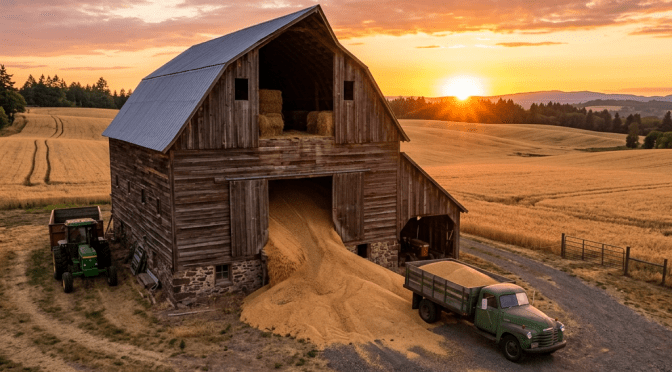
A farmer had an abundant crop and was able to fill his barns completely. The farmer still had goods and grains needing stored, but he had no room in his barns. He decided he would build bigger barns so he could tightly hold on to everything he harvested. His plan was to save for years to come.
The farmer told himself, “I can relax, eat, drink, and be merry for years to come,” but the Lord, in Luke 12:20, said to him, “You fool, you will die this very night, then who will get everything you have worked for?”
Jesus goes on in Luke 12:21, “Yes, a person is a fool to store up earthly wealth, but not have a rich relationship with God.”
There is certainly nothing wrong with saving for retirement and being responsible with our money. In fact, Scripture encourages us to handle our wealth responsibly. Being generous is part of the responsibility we have in handling what we have been given.
Jesus says in Luke 12:15, “Beware, guard against every kind of greed. Life is not measured by how much you own.”
Proverbs 11:17 states, “Your kindness will reward you, but your cruelty will destroy you.”
Solomon goes on in Proverbs 11, “Give freely and become wealthier. Be stingy and lose everything. The generous will prosper, those who refresh others will themselves be refreshed.”
“Trust in your money and down you go, but the Godly flourish like leaves in spring,” Proverbs 11:28 continues.
Generosity is not an old-fashioned principle. The world is in need of generous people now more than ever. We can be generous with our time, our love, and our money. Jesus says it is better to give than receive. How will you be generous today?

