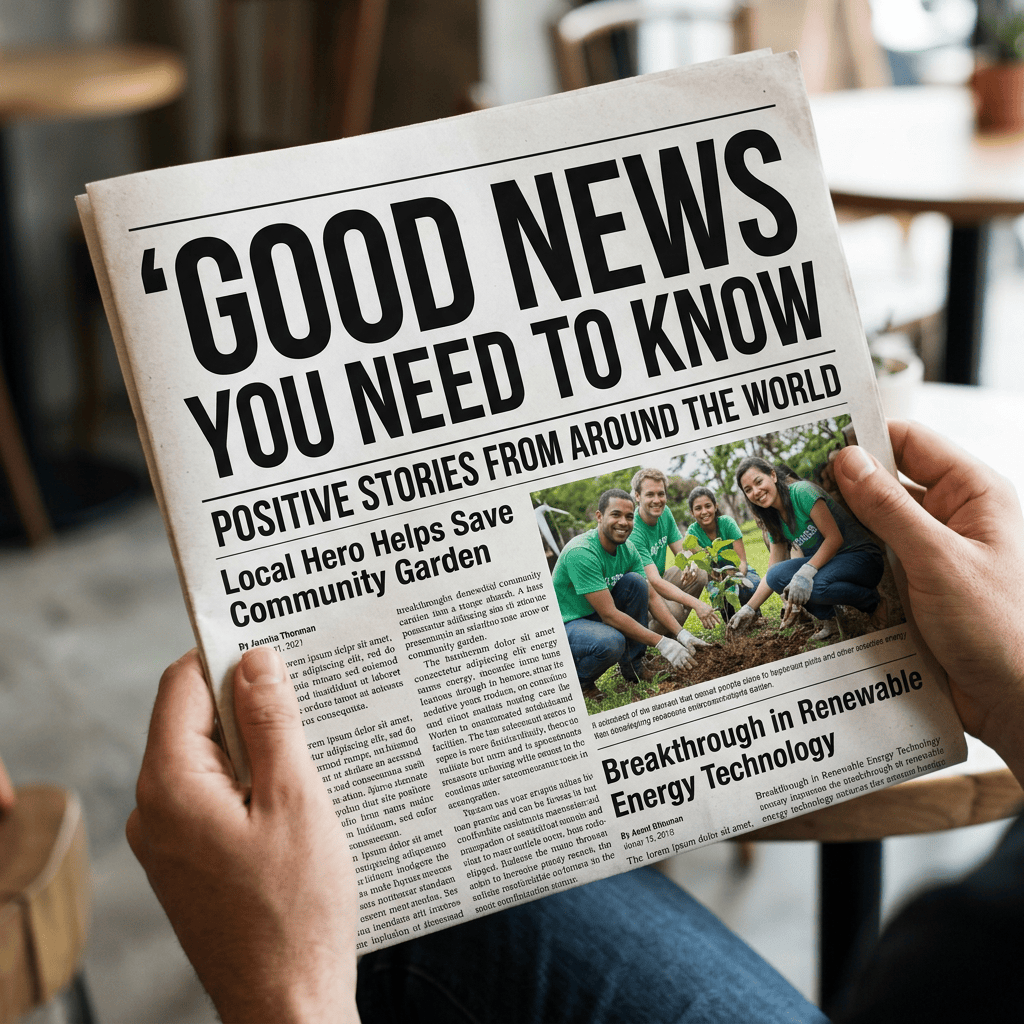
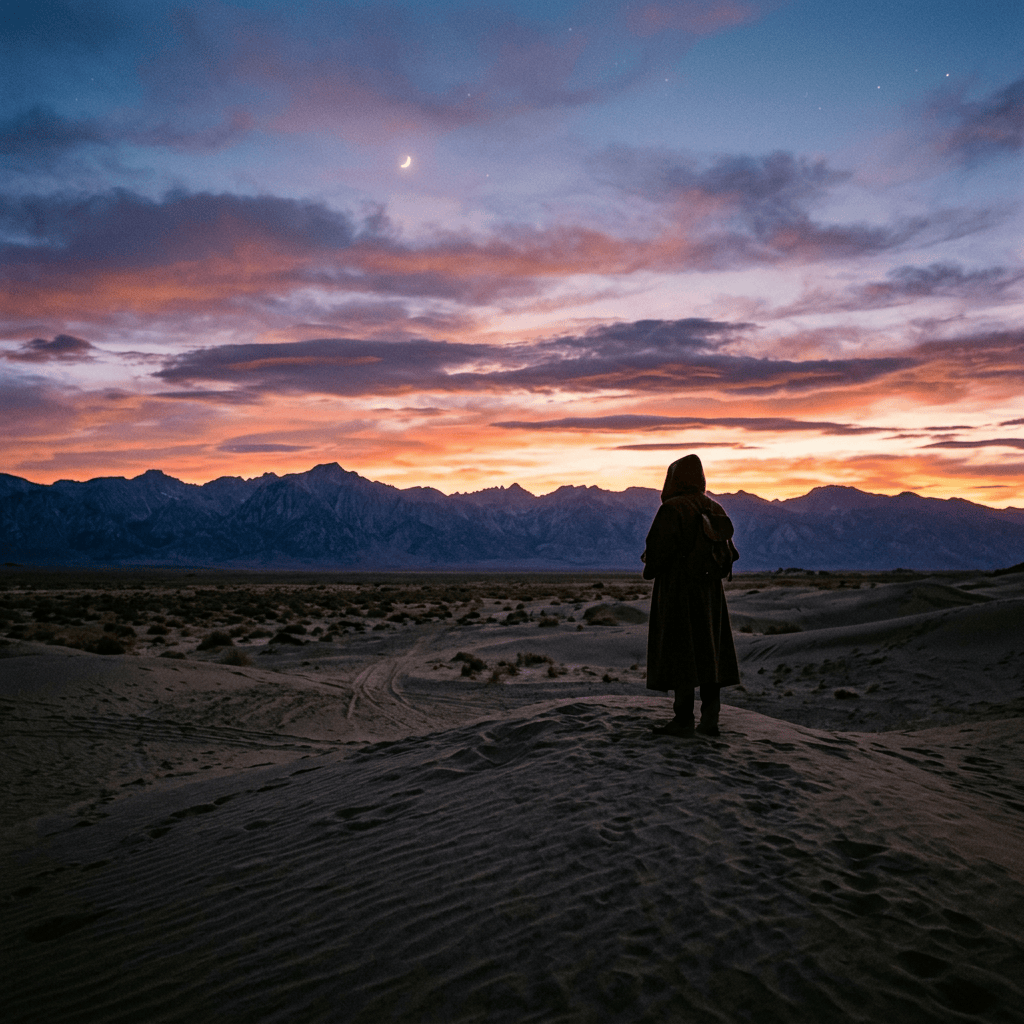
If you’ve spent much time watching the news lately, you know that discouraging stories seem to come one after another. Conflict, tragedy, and uncertainty often dominate the headlines, making it easy to believe there’s not much to celebrate.
In fact, followers of Christ have reason to celebrate every day because the Lord is continually at work. James writes, “Whatever is good and perfect is a gift coming down to us from God our Father…” (James 1:17).
Every answered prayer, every restored relationship, every encouraging phone call, every healing, every act of kindness, and every peaceful moment with the people we love is evidence of God’s goodness.
The problem is that these moments rarely become national headlines.
The evening news won’t tell you about the parent who finally found peace after months of anxiety. It probably won’t report on the marriage that was restored, the neighbor who quietly met someone’s need, or the person who discovered hope in Christ. Yet these are the kinds of miracles God performs every single day.
Sometimes we’ve become so accustomed to hearing bad news that we stop noticing the good.
Today, take a few moments to reflect on the blessings God has placed in your own life. Think about the prayers he has answered. Remember how he has carried you through difficult seasons. Celebrate the people he has given you. Thank him for His faithfulness.
The headlines never tell the whole story.
God is still healing, providing, answering prayer, changing lives, and he is still writing stories of hope. This includes yours.
As the psalmist says, “Let all that I am praise the Lord; may I never forget the good things he does for me” (Psalm 103:2).
Today, don’t let the world’s bad news drown out the good news of God’s faithfulness.
Thanks for reading, and consider subscribing for daily encouragement.
Pip: Welcome to Get Encouraged — where the parking lot is a moral classroom and the waiting room has a psalm on the wall.
Mara: Chris Miller's recent posts cover three stretches of territory: choosing kindness in everyday moments, finding strength while waiting on God, and the courage it takes to step into new roles and new seasons.
Pip: Real ground, all of it. Let's start with those everyday moments of kindness — and what we actually do when the choice is right in front of us.
Choosing Kindness in Everyday Moments
Mara: Every day drops small decisions in our path — the stranger at the intersection, the difficult person in line — and the question is simply how we respond.
Pip: The post "Choosing Kindness: A Lesson from the Parking Lot" sets it up plainly, drawing from Psalm 37: "Trust in the Lord and do good. Then you will live safely in the land and prosper."
Mara: The upshot is that faith isn't just interior — it's the thing that drives the response. You may not know the full story behind someone's need, but the directive stays the same: do good.
Pip: And the post doesn't leave it abstract. A man outside a Bob Evans was holding a sign asking for food money. They gave him enough for a meal. Small act, clear principle.
Mara: That same territory — who actually stops to help — gets explored in the podcast episode "Who Will Stop? Encouragement from the Good Samaritan," which draws the same thread through the parable. The question isn't whether the need is legitimate. It's whether we're willing to be the one who stops.
Pip: Kindness as a daily practice is one thing. But what about the seasons when doing good means mostly waiting?
Waiting, Trusting, and Finding Strength
Mara: Waiting is the frame here — not passive resignation, but an active choice to trust when the timeline isn't yours.
Pip: "Finding Strength in Waiting" reaches for Psalm 27:14 directly: "Wait for the Lord; be strong and take heart and wait for the Lord."
Mara: What this means in practice is that courage and waiting aren't opposites. The post argues the greatest act of courage is sometimes choosing not to charge ahead on your own.
Pip: "Waiting with Faith: Biblical Encouragement for Life's Delays" makes the same case from Isaiah 64:4 — that God works specifically for those who wait. And "Overcoming Exhaustion: Trusting God's Strength" addresses what happens when the waiting drains you — Isaiah's promise that those who trust the Lord will find renewed strength.
Mara: Waiting and courage turn out to be the same muscle. Which connects directly to what courage looks like when life asks you to step into something new.
Courage, Change, and the Shape of Fatherhood
Mara: This segment sits at the intersection of courage and family — what it looks like to step into a role you didn't expect, or a season you didn't plan.
Pip: "Celebrating All Types of Dads This Father's Day" makes the case directly: "Fatherhood is far more than biology. It is sacrifice. It is patience. It is showing up day after day."
Mara: The stakes there are real. The post honors stepdads, foster dads, adoptive dads — men who chose fatherhood through love rather than circumstance. Psalm 68:5 frames it as a reflection of how God himself cares for the fatherless.
Pip: "Lessons on Fatherhood from Joseph's Story" fills that out with a specific example — Joseph's response to an impossible situation was compassion first, then obedience, then quiet consistency. Loud isn't the same as faithful.
Mara: And "Embrace New Adventures with Courage" pulls it wider — any new role, any unfamiliar threshold. The call is the same: be strong and courageous, because God goes before you.
Pip: Courage as a posture, not a feeling. That's the thread running through all of it.
Mara: Kindness in small moments, strength in long seasons, courage at new thresholds — it's a practical map for ordinary days.
Pip: And apparently, a Bob Evans parking lot is as good a place as any to start. More soon.
God often shows up in the places we least expect. For someone who has hit rock bottom, He may work through a person who takes the time to listen and offer hope. For a struggling parent, He may provide encouragement through a friend’s timely advice. For a husband or wife who feels like giving up on their marriage, He may speak through an older couple who has walked the same road and reminds them not to lose heart. We never really know where God will reveal Himself.
The Lord is not confined to a church building or a Sunday morning worship service. He is present in our everyday lives, working through ordinary people and ordinary moments. He promises to be with us wherever we go. Psalm 138:8 says, “The Lord will work out his plans for my life. For your faithful love, O Lord, endures forever. Don’t abandon me, for you made me.”
Today, slow down enough to notice His presence. Before you rush into your day, ask God to open your eyes to the ways He is working around you. Pay attention to the unexpected conversation, the encouraging text message, the opportunity to help someone, or the moment of peace in the middle of a busy schedule. Those seemingly ordinary moments may be God’s way of reminding you that He is near.
You never know when—or through whom—the Lord will show up. Keep your eyes open, your heart attentive, and your hands ready to join Him in what He is already doing.
Thanks for reading, and consider subscribing for daily encouragement.
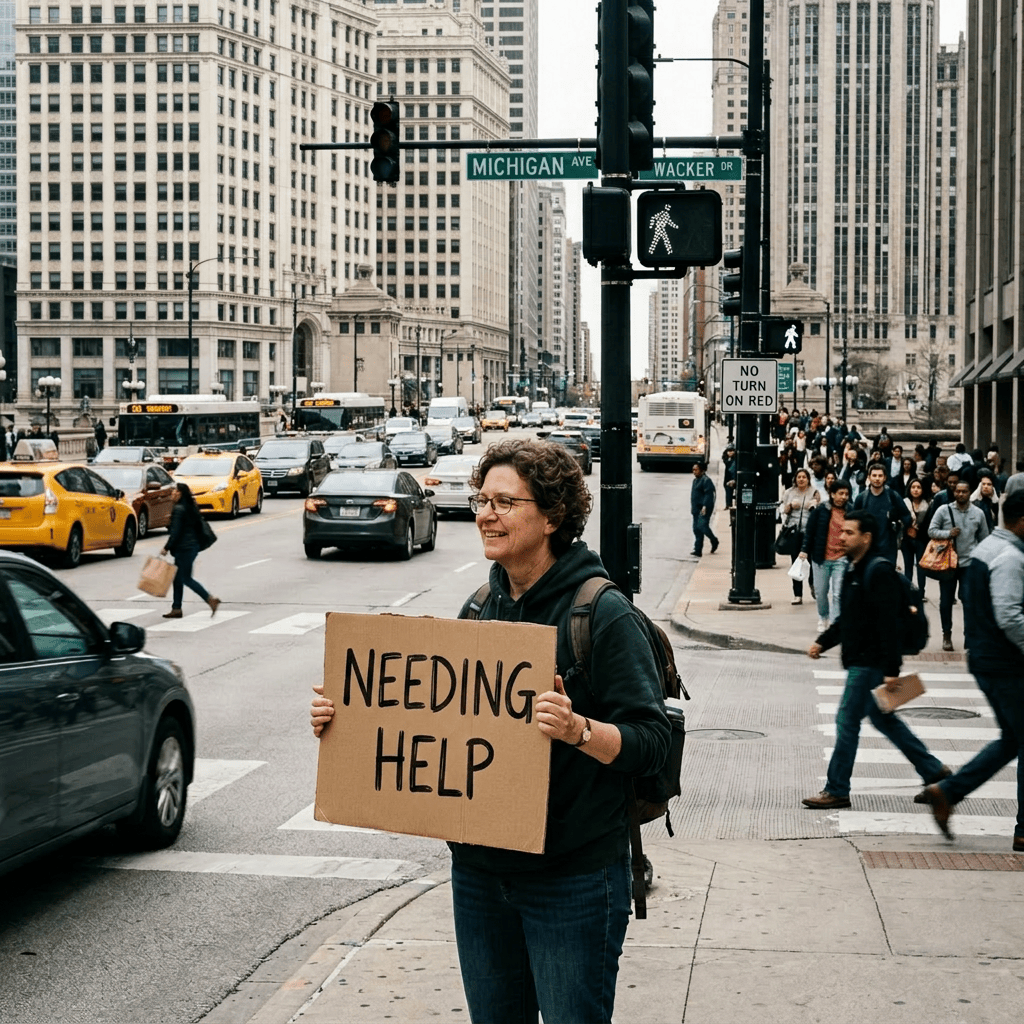
We pulled into the Bob Evans parking lot, and our daughter noticed a gentleman standing between the parking lot and street. He was holding a sign at the intersection of two busy roads. She read the sign and asked if we could give him some money. His sign was requesting money for food.
How were we going to respond to his request?
We didn’t know the man, but we were faced with a choice. This is just one example of an everyday occurrence; each day we are given the choice of how to respond to various situations. Whether it is the guy in the parking lot with a sign or the lady in front of us in line, we have to choose how to interact. We have to decide how to respond to that driver who cut us off in traffic or that grouchy person who bumped into us on the bus. Each day brings a new set of opportunities needing our response, and Psalm 37 gives us a pattern to follow.
Verse 3 says, “Trust in the Lord and do good. Then you will live safely in the land and prosper.”
The Psalmist encourages us to use these opportunities to do good. As we trust in the Lord, we should allow our faith to drive us to doing what is right even if others are doing what is wrong. We should allow our faith to guide us to do what is good. We may not know every detail of each situation, but the Lord does. When these opportunities come, our response should always be to do good.
As for the guy in the Bob Evans parking lot, we didn’t know his situation. All we knew is he was holding a sign asking for help, so we gave him enough money for a meal. He said thank you, and we went on our way. We’ll probably never cross paths again, but I hope by our doing good, the man at least saw a glimpse of Christ’s grace.
Life often feels like standing at the edge of the unknown. A new job, a difficult diagnosis, a growing family, an unexpected setback, or a door God is opening can all leave us wondering what comes next. In those moments, courage isn’t the absence of fear. It’s choosing to trust God even when we can’t see the entire picture.
Psalm 27:14 says, “Wait for the Lord; be strong and take heart and wait for the Lord.”
Notice that David connects courage with waiting on God. We often think courage means charging ahead on our own. We imagine it looks like having all the answers, making bold decisions, and never hesitating.
Sometimes, though, the greatest act of courage is choosing to wait.
Waiting on God means:
Trusting God’s timing, even when His schedule doesn’t match ours.
Following God’s direction instead of rushing ahead with our own plans.
Depending on God’s strength when we realize our own isn’t enough.
Waiting isn’t passive. It’s an active expression of faith. Every day we choose to trust God, obey His Word, and remain faithful, we’re demonstrating the kind of courage David describes.
Today, take the next step God has placed in front of you. You don’t need to have every answer. You don’t need to see the entire path. You simply need to trust the One who does.
The God who has faithfully carried you through every season of your life will not stop now. Be strong. Take heart. Wait on the Lord. He is with you every step of the way, and He is faithful to lead you exactly where you need to go.
Thanks for reading, and subscribe for daily encouragement.
Life can be scary. New adventures can be frightening. Starting that new job, opening yourself up to new relationships, becoming a parent for the first time are exciting, but they can also be unnerving. The Bible reminds us in these moments we can “be strong and courageous” (Psalm 27:14).
The truth is courage is not the absence of fear. Courage is moving forward despite our fears. Fear tells us to stay where we are because it feels safe. Courage trusts God enough to take the next step even when we do not know exactly what lies ahead.
David understood this well. He faced giants, battles, betrayals, and countless uncertain situations. Yet, in the middle of those challenges, he learned where true strength came from. His confidence was not rooted in his own abilities. Rather, his confidence was rooted in the Lord.
The same is true for us today. We can face uncertain situations because God goes before us. We can step into unfamiliar territory because He is already there. We can trust Him with our future because He holds it securely in His hands.
Perhaps you are standing at the edge of a new adventure today. Maybe you are considering a career change, taking a step of faith, or walking through a challenge you never expected. Whatever is causing your heart to race, remember that God has not abandoned you. You can walk into the new adventure with bravery and courage.
Have you been waiting? This can be one of the most difficult parts of life. We live in a super connected world, so if we have to wait longer than 10 seconds for anything, it is hard. Yet, our lives sometimes take us down paths that require us to wait.
We have to wait to see if we’re going to get our dream job. We have to wait to meet the person we desire to marry. We have to wait as we’re trying to have a family. We have to wait on our prayers to be answered.
The people of Israel also had to wait. They find themselves in a hard time. Their bondage has been harsh, and they have suffered immensely. They are needing and wanting the Lord to work, but they have to wait. As they wait, Isaiah brings encouragement, and it is still encouragement for us today.
Isaiah 64:4 says, “For since the world began, no ear has heard and no eye has seen a God like you, who works for those who wait for him!”
Hang in there if you’re waiting. Psalm 27:14 encourages, “Wait patiently for the Lord. Be brave and courageous. Yes, wait patiently for the Lord.” The Bible promises the Lord is working on your behalf.
Pip: Get Encouraged is doing what it says on the tin this week — Chris Miller has been writing about storms, gratitude, kindness, and freedom, and somehow none of it feels like a motivational poster.
Mara: That's the territory we're covering today: finding assurance when life gets hard, noticing the beauty that's already around us, choosing love in a chaotic world, and reflecting on what freedom really means.
Pip: Let's start with what to do when the water is rising.
Holding Steady Through the Storm
Mara: The question here is whether God's presence actually changes anything when life gets difficult — not in theory, but in the middle of the hardship itself.
Pip: Isaiah 43:2 is the anchor, and the setup matters: God isn't promising an easy road. The verse reads, "When you pass through the waters, I will be with you; and through the rivers, they shall not overflow you. When you walk through the fire, you shall not be burned, neither shall the flame kindle upon you."
Mara: Notice the word "when," not "if." The post makes this explicit — God doesn't promise the absence of hard seasons, only His presence through them. That reframe is the whole point.
Pip: Noah, the Israelites at the Red Sea, Shadrach and his friends in the furnace — the pattern holds across the whole story. The waters are temporary; the presence isn't.
Mara: And the piece on building bigger barns extends this in an unexpected direction — it's a warning that stockpiling security can become its own kind of storm, one we create ourselves by losing sight of what actually lasts.
Pip: From floods to gratitude — the view from creation is next.
Creation, Beauty, and Giving Thanks
Mara: The thread running through these posts is attention — specifically, what happens when we slow down enough to notice what's already there.
Pip: Psalm 19:1 does the heavy lifting: "The heavens declare the glory of God; the skies proclaim the work of his hands." Creation isn't decoration; it's testimony.
Mara: The post on recognizing daily blessings puts a human face on the cost of not paying attention — a father who grumbles before every prayer, until his daughter asks which one God actually believes.
Pip: That question lands harder than most sermons.
Mara: It does. Both posts point the same direction: slow down, look around, and thank God for ten specific blessings today. The practice matters as much as the principle.
Pip: Speaking of practice — kindness is next, and it turns out there are seven ways to do it.
Kindness as a Daily Decision
Pip: The tension in this segment is real: the world is loud and chaotic, and choosing kindness can feel like bringing a candle to a wildfire. These posts argue it's exactly the right tool.
Mara: The post on embracing kindness in a chaotic world grounds everything in a specific model. Jesus touched a man with leprosy when others avoided him, fed a hungry crowd rather than sending them home, and the post names why: "Jesus was compelled by love and moved by compassion."
Pip: That phrase — compelled by love, moved by compassion — is doing a lot of work. It's not describing an occasional mood; it's describing an orientation.
Mara: Philippians 2:5 is the challenge the post issues directly: adopt the same attitude as Christ Jesus. Not admire it. Adopt it.
Pip: Which is where the practical piece comes in. The post on seven ways to be messengers of love takes that challenge and breaks it into actual decisions — choosing patience over anger, speaking words that heal, refusing to spread gossip.
Mara: First Corinthians 13 is the spine there: "Love does not delight in evil, but rejoices with the truth. It always protects, always trusts, always hopes, always perseveres. Love never fails."
Pip: That list of seven isn't abstract. Pray for people you struggle with. Persevere with difficult relationships. Perform one act of kindness before the day ends without expecting anything back.
Mara: The post frames love explicitly as a decision, not a feeling — especially when frustration or bitterness would be the easier response. That's the whole argument in one line.
Pip: Freedom deserves the same kind of attention — and that's exactly where we land next.
Freedom, Justice, and What God Sees
Mara: Juneteenth is the anchor here — not as history lesson alone, but as a lens for understanding what freedom means and why it matters to God.
Pip: The post goes straight to the historical weight: on June 19, 1865, enslaved people in Galveston, Texas finally heard the news that had been true for more than two years. The delay is the point.
Mara: And the scriptural parallel is direct. Exodus 3:7 — "I have surely seen the affliction of my people… and have heard their cry." God was not absent from their suffering. He was working toward deliverance.
Pip: The post connects that to John 8:36 and the freedom Christ brings — not as a pivot away from the historical reality, but as an extension of the same truth: every person carries dignity, and justice reflects the heart of God.
Mara: The call is practical: pray for healing, choose understanding over anger, treat every person as someone made in the image of God. Freedom is worth celebrating, and love is always worth living out.
Pip: Presence in the storm, beauty in the ordinary, kindness as a daily choice, freedom as something worth protecting — that's a week's worth of reminders that hold together.
Mara: All of it points the same direction: pay attention, and then act on what you see.
The Lord’s fingerprints can be found all over creation.
The beautiful sunrise stretching over the mountains is His work. The calming sound of ocean waves rolling onto the seashore is His work. The awe of stars twinkling and the moon shining in a darkened sky is His work. Everywhere we look, we can see reminders of the power, creativity, and love of God.
Psalm 19:1 says, “The heavens declare the glory of God; the skies proclaim the work of his hands.”
Creation points us to the Creator.
Sometimes life becomes so busy that we rush through our days without noticing the beauty around us. We become focused on schedules, responsibilities, problems, and distractions. Yet, even in the middle of hectic days, God surrounds us with reminders that He is near.
A sunrise reminds us His mercies are new every morning.
The rain reminds us He refreshes dry places.
The stars remind us of His greatness and power.
Every detail of creation quietly whispers that we are not alone.
But perhaps one of the greatest masterpieces God has ever created is you.
Your life is not an accident. Your story matters. The Lord carefully formed you with purpose, love, and intention. Even when you cannot fully see what He is doing, He is still working. The same God who painted the skies and formed the oceans is shaping your life into something beautiful.
Ephesians 2:10 says, “For we are God’s masterpiece. He has created us anew in Christ Jesus, so we can do the good things he planned for us long ago.”
The Lord is everywhere. He is not confined to a building or restrained to a single geographical location. His presence fills the earth. His love can be seen in both the grand wonders of creation and the quiet moments of everyday life.
Take a moment today to slow down and notice the beauty before you. Watch the sunrise. Listen to the birds sing. Feel the breeze. Gaze into the night sky. And as you do, thank the Lord for what He has done.
Creation is a beautiful testimony of His love for you and me.
A husband had a habit of grumbling about the food his wife prepared for meals. He would grumble, then offer a prayer of thanksgiving. His pattern of grumbling then thanking was the same every day.
One day his young daughter asked, “Dad, does God hear our prayers?”
“Why yes,” the father replied.
The daughter continued, “Does God hear everything else we say?”
“Of course,” the dad said. He was bubbling with pride because he had inspired his child to ask spiritual questions.
His pride quickly turned to embarrassment and humility when the daughter asked, “Well, which one does he believe: your grumbling or thanksgiving?”
Blessings can come in all shapes and sizes, and Psalm 136 encourages us to give thanks to the Lord for all that he has done for us.
Verses 1-3 say, “Give thanks to the Lord, for he is good. His faithful love endures forever. Give thanks to the God of gods. His faithful love endures forever. Give thanks to the Lord of lords. His faithful love endures forever.”
The Psalmist gives us some reasons to give thanks.
Give thanks for the mighty miracles God performs.
Give thanks for the beautiful creation surrounding us.
Give thanks to him for the freedom he brings.
Give thanks to him for the provisions he provides.
Give thanks to him for his past actions.
Give thanks to him for his present grace.
Give thanks to him for his grace and love. We are reminded 26 times the Lord’s faithful love endures forever.
With current events, it is easy to forget how many times we have been blessed, yet there is much for which we can be thankful.
Helen Keller said, “So much has been given to me that I have no time to ponder that which I don’t have.” There are many reasons we have to be grateful. Take time today to thank God for 10 of your blessings.