Pip: Get Encouraged lives up to its name this week — storms, fish, and a holiday cookout all end up pointing somewhere eternal.
Mara: Chris Miller has been writing about hope that holds under pressure, the surprising shapes divine answers can take, and the freedom that outlasts any fireworks display. Let's start with what it actually looks like to find hope in the middle of a trial.
Hope That Holds When Everything Else Doesn't
Pip: The question running through this whole segment is whether hope is just a feeling we conjure when things are going okay, or whether it's something that reaches into the worst moments — hospital rooms, doctor's offices, the dark quiet of a car after bad news.
Mara: The post "Still Offering Hope" opens with a story that makes the case without arguing it. A teacher visits a severely burned boy to help with a grammar assignment, leaves feeling she accomplished nothing, and then hears from a nurse the next day: "I don't know what you did yesterday, but the patient's outlook has completely changed. He is fighting back and responding to treatment."
Pip: She showed up to teach nouns and adverbs, and what she actually delivered was proof that someone thought he was worth teaching — that he had a future worth preparing for.
Mara: That's exactly the connection the post draws. The boy later explained: "They wouldn't send a teacher to work on homework with a dying boy, would they?" The act itself was the message. And the post ties that directly to Isaiah 1:18, where God says, "Come now, let us settle the matter — though your sins are like scarlet, they shall be as white as snow."
Pip: God showing up is itself the signal that the situation isn't terminal.
Mara: "Finding Strength in Stormy Times" builds on that with Isaiah 43, which is careful about one word: when. Not if you pass through the waters — when. Hardship is assumed. What changes is who's in it with you.
Pip: And "The One Hope that Never Changes" names the contrast plainly — friends, politicians, savings accounts, all limited. One source isn't.
Mara: Romans 15:13 is the anchor there: God is called "the God of hope." The post draws a straight line from that title to what it means practically — light into dark places, peace into anxious hearts, purpose into painful seasons.
Pip: "Finding Hope in Life's Storms" leans on David for the same argument. A man who knew betrayal and loss firsthand wrote Psalm 18:30 anyway: "God's way is perfect. All the Lord's promises prove true. He is a shield for all who look to him for protection."
Mara: And "Healing the Brokenhearted" zeroes in on Psalm 147:3 — "He heals the brokenhearted and binds up their wounds." The post is careful to note this isn't always fast. But slow doesn't mean uncertain.
Pip: That's the thread across all of it — the answer may not look like relief, but it is presence. Which, it turns out, is exactly the setup for the next theme.
When God's Answer Arrives Unrecognizable
Pip: Jonah prayed to survive the sea, and God sent a fish. That's the shape of this segment — provision that doesn't look like provision.
Mara: Jonah 1:17 puts it plainly: "Now the Lord had arranged for a great fish to swallow Jonah, and Jonah was inside the fish for three days and three nights."
Pip: Smelly, dark, and entirely not what he asked for — and also the only reason he lived.
Mara: The post "When Answers Come in Unlikely Packages" asks directly whether we grumble at the unusual rescue or thank God for it. That same story also gets explored in the podcast episode "A Great Fish was Provided," for anyone who'd rather listen than read. The question underneath both: what if the thing that looks like a setback is actually the lifeboat?
Pip: Freedom, it turns out, can arrive in similarly unexpected wrapping — which is where we're headed next.
The Freedom That Outlasts the Fireworks
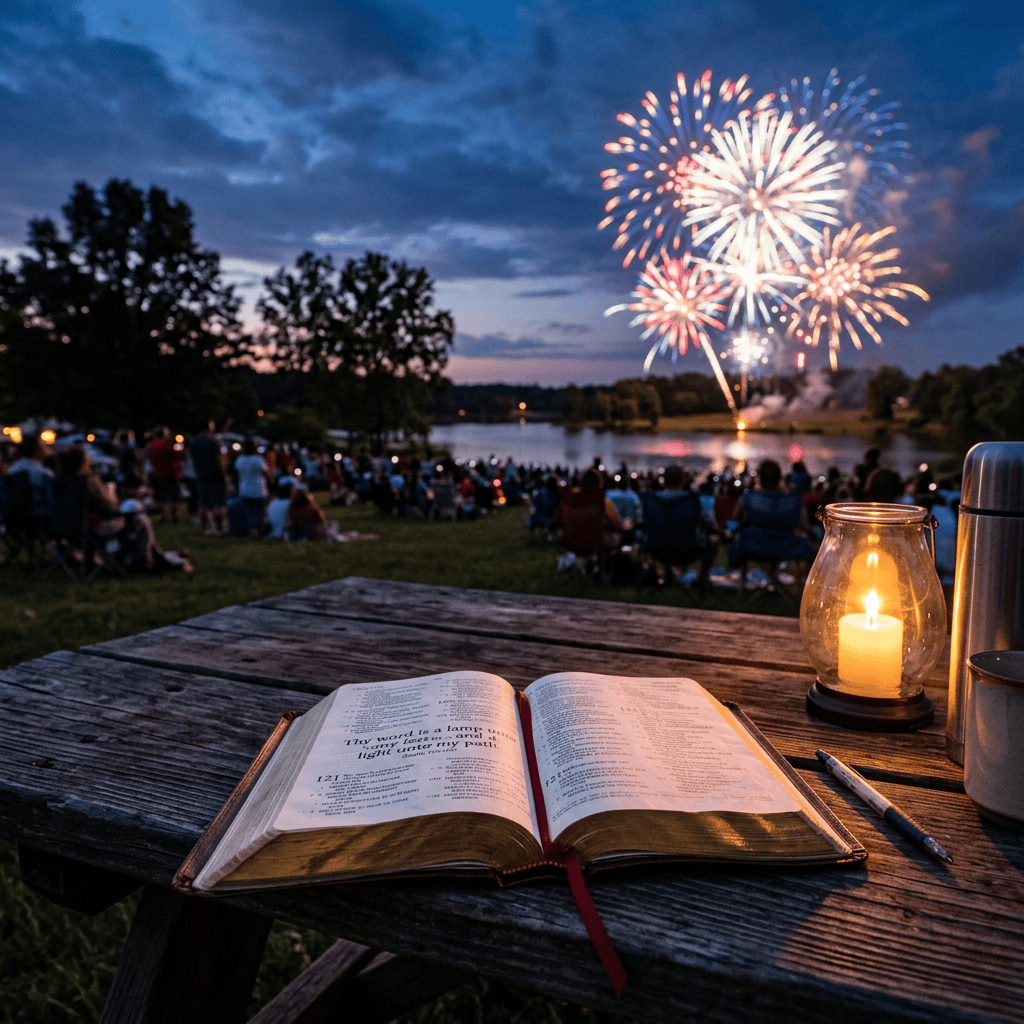
Pip: July Fourth is the frame, but "Finding Lasting Freedom Through Christ This July 4th" is after something bigger than a holiday — the kind of freedom that doesn't depend on geography or government.
Mara: Galatians 5:1 is the spine of it: "It is for freedom that Christ has set us free. Stand firm, then, and do not let yourselves be burdened again by a yoke of slavery." The post walks through what that means practically — leaving guilt with Jesus, choosing faith over fear, extending grace outward.
Pip: Celebrate the cookout, enjoy the fireworks, and then remember what the empty tomb actually secured.
Mara: John 8:36 closes it: "So if the Son sets you free, you will be free indeed." That's not a circumstantial freedom. It's a permanent one.
Pip: Hope in trials, answers in disguise, freedom that holds — the throughline is the same God showing up in forms we didn't expect.
Mara: Same territory next time, most likely. There's always more ground to cover when the subject is encouragement that actually holds.